

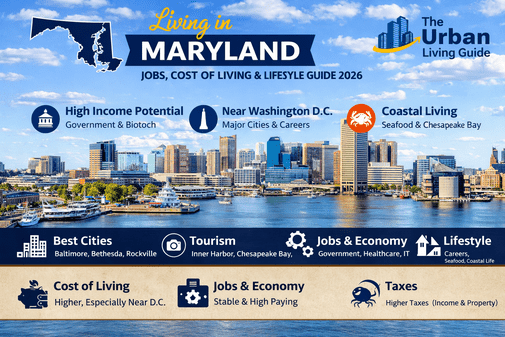
Living in Maryland: Federal Corridors, Chesapeake Culture & High-Growth Suburbs in 2026
Choosing Maryland as your home in 2026 is less about selecting a state and more about positioning yourself within one of the most critical geopolitical, intellectual, and economic corridors in the United States. Spanning over 12,407 square miles, the “Old Line State” is geographically anchored by the expansive Chesapeake Bay, the rolling Piedmont plateau, and the rugged, forested peaks of the Appalachian Mountains. As a long-term resident, you quickly realize that this state offers a striking balance: the high-velocity, global-facing corporate and federal powerhouses of the Washington D.C. suburbs contrasted with the storied, maritime-focused pace of the Tidewater coastal regions and the quiet, agricultural heritage of the Western Piedmont.
From the high-tech biotechnology campuses of Bethesda and Rockville to the industrial resurgence of Baltimore and the colonial academic charm of Annapolis, life here is characterized by deep historical roots, a population of approximately 6.2 million residents, and a recession-resistant economy anchored by the federal government, defense contracting, and life sciences. For official administrative guidelines, state tax forms, and civic resources, residents frequently consult the Official State of Maryland Portal.
| Quick Facts Snapshot: Maryland (2026) | |
|---|---|
| Time Zone | Eastern Time Zone (ET / UTC-5, Daylight Saving UTC-4) |
| State Population | Approx. 6.2 Million (High concentration in the Baltimore-Washington corridor) |
| State Income Tax | Graduated rate structure ranging from 2.0% up to 5.75% + local county surtaxes |
| Median Home Price | $380,000 – $650,000+ (Significant premium in Montgomery County vs. Western rural zones) |
| Average Rent Range | $1,600 – $3,200+ per month (Dependent heavily on D.C. metro proximity) |
| Sales Tax Baseline | 6.0% state-wide base with no local option sales tax additions |
What Makes Maryland So Distinctive in 2026
Living in the Free State means navigating a complex landscape defined by its profound colonial legacy and modern technological resilience. Unlike states with singular cultural identities, Maryland thrives on the friction and cooperation between its historical roots and the high-tech, government-contracting future of the I-270 Biotech Corridor.
Locals quickly understand that day-to-day existence depends entirely on your zip code: whether you reside in the transit-dense, high-cost D.C. commuter belt, the industrial-creative districts of Baltimore, or the lush, agricultural valley floors. The resident trade-off is clear: you accept the higher cost of living and rigorous property assessments in exchange for access to arguably the best-funded public school systems in the nation, elite medical complexes, and job market stability that is unrivaled due to the constant presence of federal agencies and the Department of Defense. Explore regional heritage and lifestyle guides via the Maryland Office of Tourism.
- Geographic Reach: From the barrier islands and fishing villages of the Chesapeake Bay to the high-elevation slopes of the Blue Ridge Mountains in the far west.
- Economic Identity: A stable, recession-resistant economy anchored by the National Institutes of Health (NIH), NASA Goddard, and thousands of private-sector defense contractors.
- Cultural Heritage: A sophisticated blend of 18th-century historical sites, university-driven innovation, and a blue-collar, seafaring maritime culture that permeates the food and recreation sectors.
Regional Diversity, Geography & Economic Zones of Maryland
Because Maryland stretches from the Atlantic seaboard to the Appalachian foothills, its geography encompasses starkly contrasting zones that dictate entirely separate daily living experiences.
The Metropolitan & High-Tech Corridor
- Northern & Central Maryland: Encompassing Montgomery, Howard, and Prince George’s counties—serving as the massive suburban extension of Washington D.C., home to the majority of the state’s biotech and IT clusters.
- The Baltimore Metro: Functioning as a distinct urban entity, providing a mix of historic row-home architecture, world-class shipping infrastructure, and massive healthcare research institutions.
The Coastal, Inland & Appalachian Belts
- The Eastern Shore: A flat, low-lying coastal peninsula separated by the Chesapeake Bay, defined by seafood, agriculture, and summer tourism.
- Western Maryland (The Appalachian Frontier): Characterized by dramatic mountain ridges, heavy forestry, and small-town commerce, offering a vastly more affordable and quiet lifestyle compared to the I-95 corridor.
Infrastructure, Power Grids, Water Systems & Transport Networks in Maryland
Sustaining over 6 million residents in a high-density, water-sensitive environment requires sophisticated engineering and an integrated transit web.
Water Resources & The Chesapeake Bay
- Chesapeake Bay Management: The bay is the state’s ecological and economic heart. Management of the watershed is handled by agencies working to balance urban density with environmental stewardship. Learn more via the Maryland Department of the Environment.
- River Basins: The Potomac and Susquehanna rivers are vital for municipal water supplies and historical transportation routes.
Power Generation & Energy Frameworks
- Grid Reliability: Electricity is supplied via Baltimore Gas and Electric (BGE) and Pepco, integrating traditional generation with rapidly increasing offshore wind and solar mandates.
Statewide Transit, Rail, Air & Port Connectivity
- Commuter Transit: The MARC Train (Maryland Area Regional Commuter) is the lifeline for thousands of daily commuters traveling between Baltimore and D.C., while WMATA Metro serves the NoVA-D.C. border communities.
- Aviation Gateways: International travel is anchored by BWI Thurgood Marshall Airport, a major hub for Southwest Airlines and international cargo.
- Maritime Power: The Port of Baltimore is a top-tier U.S. facility, leading the nation in automotive imports and handling immense containerized freight.
Job Market and Economic Power of Maryland
The state economy functions as a premier nerve center for national security, medical research, and corporate operations.
- GDP Powerhouse: One of the highest median household incomes in the U.S., driven by high-skill federal contracts and private research firms.
- Dominant Sectors: Biotechnology (the “BioHealth Capital Region”), cybersecurity, healthcare research, defense engineering, and commercial banking.
- Major Employers: Headquarters and operational hubs for Lockheed Martin, Northrop Grumman, Under Armour, and T. Rowe Price. Track state economic development via Maryland Department of Commerce.
Salary Realities Across Economic Corridors
- Metropolitan Potential: Specialized roles in cybersecurity, pharma-research, and government management in the Bethesda/Rockville corridor command average professional salaries well above national medians, often exceeding $120,000 to $175,000+.
- Regional Wage Variance: Wages in Western Maryland align closer to national medians, offset by lower housing and service costs.
Cost of Living Realities & Housing Market Variance
Living here requires careful budget planning. Expenses range from some of the most expensive housing markets near the D.C. metro border to highly affordable, historic housing in interior regional hubs.
| Expense Category | Cost Range / Index Reality |
|---|---|
| Housing (Metro vs. Regional) | $2,000–$3,500+ monthly in Bethesda/Rockville; $1,100–$1,700 in rural western/eastern counties |
| Utilities & Heating | Aligns with national averages; seasonal A/C and heating are standard |
| Transportation | Significant monthly budget allocation for tolls (Turnpike/ICC) and fuel in NoVA suburbs |
| Groceries & Goods | Reflects the premium service-oriented nature of the regional retail economy |
State Tax Climate, Business Environment & Government Policies
The state operates under a regulated, high-service governance model characterized by progressive taxation and massive investments in transit and education. Review tax compliance guidelines via the Maryland Comptroller.
- Income Tax Structure: A graduated bracket system that requires careful withholding planning for high-earning households.
- Property Tax Pressures: County governments manage real estate assessments, resulting in effective property tax rates that vary significantly by school district and municipal services.
Legal & Lifestyle Governance Quirks
- Vehicle Titling: New residents must secure a Maryland driver’s license and transfer vehicle registrations at the Motor Vehicle Administration (MVA) within 60 days of residency.
- Vehicle Property Tax: Many counties include vehicle personal property tax within annual registration cycles.
Climate, Weather Extremes & Natural Geography
The state experiences a classic humid subtropical climate with warm, humid summers and cool-to-cold winters.
- Seasonal Variations: Summers bring heavy humidity, particularly near the bay, while winters range from mild coastal rain to heavy mountain snows in the west.
- Environmental Realities: Residents maintain preparedness for summer tropical storm impacts, springtime severe weather, and regional flooding near coastal basins.
Insurance Cost Realities (Disaster & Weather Risks)
- Coastal Flood/Storm Riders: Properties along the Chesapeake and coastal areas require mandatory flood insurance and specialized windstorm endorsements.
Education Systems & Major Healthcare Networks
Elite academic institutions and global medical complexes anchor the state’s institutional prestige. Explore public health data via the Maryland Department of Health.
- Higher Education Framework: Home to institutions like Johns Hopkins University and the University of Maryland system.
- Advanced Healthcare: Elite networks like Johns Hopkins Health System and MedStar Health provide world-class clinical care.
Culture, Outdoor Recreation & Lifestyle Shifts
Daily life in Maryland spans unmatched maritime history, sophisticated urbanity, and scenic state parks. Explore recreation via Maryland DNR.
- Outdoor Living: Crabbing and boating on the Chesapeake Bay, hiking in Deep Creek Lake, and visiting the historic National Harbor.
- Arts & Entertainment: Global dining, the Baltimore Symphony, and a historic culinary scene defined by legendary Maryland blue crabs.
Relocation & State Residency Essentials
- MVA Transfers: New residents have a 60-day window to secure a Maryland driver’s license and register motor vehicles.
- Voter Registration: Easily managed online via the Maryland State Board of Elections.
Major Counties and Rural Living Realities in Maryland
- Montgomery County: The corporate and biotech engine, suburban, dense, and affluent.
- Prince George’s County: A diverse, rapidly growing community with strong public transit links.
- Baltimore County: Balancing urban proximity with historic, suburban residential development.
Major Regional Hubs and Cities to Explore
Major Urban Hubs at a Glance
| City / Hub | Primary Driver | Vibe & Lifestyle Profile |
|---|---|---|
| Baltimore | Logistics, Healthcare | Historic, industrial, artsy |
| Rockville | Biotech, Tech | Corporate, dense, affluent |
| Bethesda | Defense, Federal Gov | Premium, walkable, elite |
| Annapolis | Gov, Maritime | Colonial, coastal, charming |
| Frederick | Growth, Logistics | Balanced, historical, family-oriented |
Detailed Breakdown of Key Regional Hubs
Baltimore — The Resilient Harbor City
Baltimore is a historic maritime engine. It offers some of the most affordable housing in the region, revitalized waterfront districts, and massive medical research institutions.
Rockville — The Biotech Corridor Anchor
Situated in the heart of Montgomery County, Rockville serves as a global hub for life sciences, providing high-paying technical careers and excellent suburban amenities.
Bethesda — The D.C. Suburban Elite
Bethesda is known for its high-end dining, shopping, and proximity to major NIH and defense research facilities, catering to a sophisticated professional demographic.
Annapolis — The Historic Maritime Capital
Annapolis anchors the state with maritime history and colonial charm, serving as the cultural heart of the Chesapeake region.
Frederick — The Balanced Suburban Hub
Frederick offers an attractive blend of historic downtown charm and modern suburban growth, serving as an increasingly popular hub for commuters and local industry alike.
Pros and Cons of Making Maryland Your Home
| Advantages (Pros) | Systemic Drawbacks (Cons) |
|---|---|
| Elite job density in tech and defense sectors | Heavy congestion on the Beltway and I-95 |
| World-class public and university education | High property taxes in top-tier school zones |
| Proximity to Washington D.C. opportunities | Local costs of living are significantly elevated |
| Vibrant history, seafood, and coast access | Auto property taxes vary by county |
Frequently Asked Questions About Living in Maryland
Is Maryland a good state to live in?
Yes, especially if you value stable economic growth, professional opportunities in federal sectors, and a balanced lifestyle that includes both urban centers and coastal access.
What is the actual cost of living in Maryland?
It is above the national average, heavily influenced by the high demand for real estate in the counties immediately surrounding the Washington D.C. metro area.
Which region or city is best to settle down in?
It depends on your profession and commute needs: Bethesda for D.C.-based professionals, Baltimore for urban industrial revitalization, and Annapolis for coastal lovers.
Does Maryland have high taxes?
The state income tax is graduated, and property taxes in school-heavy districts can be high, but these costs fund some of the nation’s top-tier educational infrastructure.
How safe is everyday life across the state?
Safety is very high in Maryland’s many master-planned suburban communities, while urban areas require standard metropolitan caution.
What industries dominate Maryland’s job market?
The state is a global hub for biotechnology, federal defense contracting, medical research, and cybersecurity services.
What is the weather like?
Maryland features humid summers and cool-to-cold winters, with significant variation between the coastal humidity of the Bay and the cooler mountain climate of the western highlands.
Explore Detailed City Guides Across Maryland
At The Urban Living Guide (TULG), our core mission is to provide deeply researched regional insights and city-level navigation tools to help you evaluate your relocation options with total confidence. To discover what daily life, housing patterns, and local economies look like across our featured municipal centers throughout the state, explore our comprehensive resident hub guides below:
- Living in Baltimore, Maryland
- Living in Rockville, Maryland
- Living in Bethesda, Maryland
- Living in Annapolis, Maryland
- Living in Frederick, Maryland
Whether you are comparing career prospects in the global biotechnology corridor or evaluating lifestyle shifts near the Chesapeake Bay, our editorial team remains dedicated to delivering research-backed, data-driven frameworks to support your relocation and residency decisions with complete clarity.