

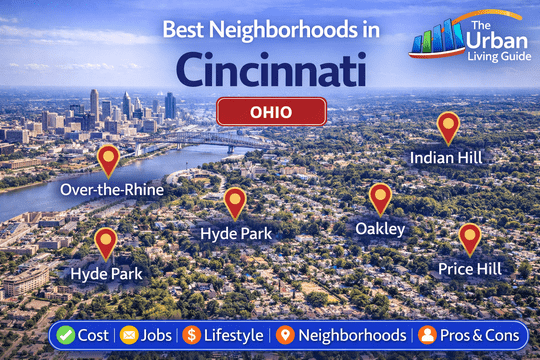
Best Neighborhoods in Cincinnati: Riverfront Squares, Historic Hills & Queen City Pockets in 2026
Covering approximately 77.9 square miles of land area across the rolling hills and limestone bluffs above the Ohio River in Hamilton County, the incorporated municipality of Cincinnati operates under the mayor-council municipal administration of the City of Cincinnati. Housing an incorporated municipal core population exceeding 309,000 residents and anchoring the broader tri-state Cincinnati metropolitan area (spanning Southwest Ohio, Northern Kentucky, and Southeast Indiana) of over 2.26 million people, the “Queen City” stands as an essential headquarters for Fortune 500 commerce, consumer goods innovation, medical research, and rich brewing heritage.
Relocating across the Queen City requires evaluating steep hill topography, distinct east-west community divides, and transit networks operated by the Southwest Ohio Regional Transit Authority (SORTA / Metro). Inbound movers consistently balance direct access to primary regional employers—including global corporate headquarters for Procter & Gamble (P&G), The Kroger Co., Fifth Third Bancorp, GE Aerospace in Evendale, and healthcare systems anchored by UC Health (University of Cincinnati Medical Center) and Cincinnati Children’s Hospital Medical Center—against daily transit commutes across Interstate 71, Interstate 75, Interstate 275 (The Loop), US Route 50 (Columbia Parkway), and historic river crossings like the John A. Roebling Suspension Bridge, with regional air links via Cincinnati/Northern Kentucky International Airport (CVG).
Join a local Cincinnati resident for an authentic neighborhood walkthrough exploring the architecture, hillside views, and daily lifestyle across the city:
Key Residential Districts in Cincinnati at a Glance in 2026
| Neighborhood | Location | Distance to Fountain Square | Development Status | Transit Connectivity | Cost Level | Best Fit For |
|---|---|---|---|---|---|---|
| Hyde Park | East Side Core | ~5 mi northeast | Historic Walkable Village & Estates | High (Metro Bus Routes, Erie Ave, I-71) | High-to-Premium | Corporate Executives, Medical Staff & Families |
| Over-the-Rhine (OTR) | Central Basin | ~0.8 mi north | Preserved 19th-Century Arts Core | Exceptional (Connector Streetcar, Vine St) | Mid-to-High | Young Professionals, Creatives & Foodies |
| Mount Adams | East Hilltop Bluff | ~1.5 mi east | Historic European-Style Hilltop | High (Metro Buses, Columbia Pkwy / US-50) | High-to-Premium | Attorneys, Physicians & Skyline View Seekers |
| Oakley | East Side Basin | ~6 mi northeast | Modern Infill & Historic Square | High (Wasson Way Trail, Madison Rd, I-71) | Mid-to-High | Young Families, Tech Staff & Commuters |
| Westwood | West Side Hills | ~5.5 mi west | Historic Suburban Infill & Town Hall | High (Metro Bus Network, Harrison Ave) | Accessible | First-Time Homebuyers, Renters & Trades |
Detailed Breakdown of Prominent Cincinnati Neighborhoods
Hyde Park — Historic Square Elegance, Grand Estates & Ault Park Overlooks
Positioned along the premier East Side corridor overlooking the Ohio River basin, Hyde Park is widely celebrated as Cincinnati’s most prestigious, architecturally distinguished, and family-oriented residential enclave. Developed extensively starting in the 1890s as an upscale streetcar suburb, the neighborhood operates under City of Cincinnati municipal administration and is championed by the Hyde Park Neighborhood Council. Centered around the iconic illuminated fountain of Hyde Park Square (Erie Avenue), the district is defined by majestic oak canopies, upscale boutiques, and grand historic estates.
The neighborhood provides an established community atmosphere within a 10-minute drive of downtown corporate headquarters, making it the primary choice for executives at Procter & Gamble, physicians, and growing households.
- Housing: Real estate stock features grand Victorian mansions on Observatory Avenue, classic 1920s brick Tudors, Colonial Revival single-family estates, and luxury boutique townhomes. Single-family purchase prices typically range from $480,000 to $1,850,000+, while residential rentals and apartment flats average $1,650 to $2,950 per month.
- Safety & Crime Rate: Patrolled by the Cincinnati Police Department (CPD) District 2 Command. Hyde Park consistently records some of the lowest violent and property crime rates in Hamilton County, supported by high owner-occupancy and active block watch networks.
- School District & Education Quality: Governed by Cincinnati Public Schools (CPS), containing top-performing public institutions such as Hyde Park School (K-6) and nearby Walnut Hills High School (nationally recognized for college preparatory curriculum), alongside premier private academies like The Summit Country Day School.
- Walkability & Daily Conveniences: Outstanding pedestrian walkability (Walk Score of 88-92/100 around the square). Residents walk to artisan bakeries, fine jewelry shops, local coffee houses, and grocers including Graeter’s Ice Cream Flagship, Hyde Park Gourmet Food & Wine, and Kroger on Hyde Park Plaza.
- Parks & Green Spaces / Pet-Friendliness: World-class natural recreation anchored by the 224-acre Ault Park (featuring formal rose gardens, pavilion overlooks across the Little Miami River valley, and summer concert series) and walking paths along the Wasson Way Trail. Exceptionally pet-friendly.
- Parking & Traffic Congestion: Plentiful private residential driveways and detached multi-car garages keep neighborhood lanes clear. Commuter traffic moves steadily, with minor slowdowns along Erie Avenue and Dana Avenue near the Interstate 71 interchange during morning rush hours.
- Noise Levels & Vibe: Refined, peaceful, and family-centered, characterized by birdsong, tree-shaded sidewalks, and calm residential evenings.
- Medical Facilities & Hospitals: Direct 8-minute commute to the Uptown medical corridor, including UC Health University of Cincinnati Medical Center and Cincinnati Children’s Hospital Medical Center.
- Transit Connectivity: Served by Metro Bus Routes (Routes 11 and 31) along Erie and Madison, offering a 12-minute ride to Fountain Square, with rapid vehicular access to Interstate 71 and Columbia Parkway (US-50).
- Affordability: High-tier price profile for Southwest Ohio; premium real estate acquisition values are balanced by elite public school catchment options, park access, and strong long-term property equity.
- Who It’s Best For: Corporate executives, legal partners, medical directors at UC Health, and families seeking classic architecture with walkable village squares.
- Drawbacks: Higher purchase entry prices, competitive parking around Hyde Park Square on Saturday mornings, and older home mechanical maintenance.
Over-the-Rhine (OTR) — Historic Italianate Architecture, Findlay Market & Streetcar Transit
Situated in the central urban basin immediately north of downtown, Over-the-Rhine (OTR) is internationally celebrated as containing the largest intact collection of 19th-century Italianate architecture in the United States. Settled extensively by German immigrants in the mid-1800s across the historic Miami and Erie Canal, the district has undergone a world-renowned urban revitalization led by the City of Cincinnati and the Cincinnati Center City Development Corporation (3CDC).
Centered along Vine Street, Main Street, and Elm Street, OTR blends historic brick architecture with craft breweries, Michelin-recognized culinary dining, contemporary art galleries, and rail transit.
- Housing: Real estate is dominated by restored 19th-century Italianate brick condominiums, converted historic brewery lofts (such as The Crown Lofts), and modern infill apartment mid-rises. Condominium purchase valuations typically range from $220,000 to $650,000+, while modern rental lofts average $1,350 to $2,350 per month.
- Safety & Crime Rate: Patrolled by the CPD District 1 Command and supported by visible 3CDC safety ambassadors. Active pedestrian dining strips along Vine Street and Washington Park maintain safe foot traffic, though standard city awareness is advised on outer peripheral blocks late at night.
- School District & Education Quality: Governed by CPS, containing specialized choice campuses such as School for Creative and Performing Arts (SCPA) (a nationally acclaimed K-12 arts institution), alongside higher education at the nearby Art Academy of Cincinnati.
- Walkability & Daily Conveniences: Outstanding pedestrian walkability (Walk Score of 94-98/100). Residents walk to over 60 restaurants, craft taprooms, and fresh grocery stalls at Ohio’s oldest continuously operated public market, the historic 1852 Findlay Market.
- Parks & Green Spaces / Pet-Friendliness: Municipal recreation is anchored by the restored 8-acre Washington Park (featuring interactive fountains, civic lawns, a dedicated turf dog park, and views of historic Cincinnati Music Hall) and Ziegler Park (featuring public Olympic swimming pools). Exceptionally pet-friendly.
- Parking & Traffic Congestion: Managed through municipal parking garages and surface lots; modern residential loft conversions provide assigned parking spaces. Surface street traffic flows smoothly with minimal congestion.
- Noise Levels & Vibe: Vibrant, historic, and creative, filled with streetcar bells, patio conversations, live music from historic halls, and active weekend market crowds.
- Medical Facilities & Hospitals: Direct 4-minute access up the hill to The Christ Hospital in Mount Auburn and UC Health.
- Transit Connectivity: Unmatched rail transit centered on the 3.6-mile rail loop of the Connector Streetcar (free fare) connecting OTR directly to Downtown Fountain Square and The Banks, supplemented by Metro Bus Routes and vehicle access to I-71 and I-75.
- Affordability: Mid-to-high urban price profile; delivers authentic vintage architectural lofts and dining convenience at rates significantly lower than East Coast or West Coast metros.
- Who It’s Best For: Young professionals, tech workers at 84.51°, designers, culinary enthusiasts, and urbanites seeking a car-optional historic lifestyle.
- Drawbacks: Monthly residential parking garage fees, late-night weekend noise near entertainment corridors, and ongoing street-level transitions on outer perimeter blocks.
Mount Adams — European Hillside Village, Eden Park Culture & Panoramic River Vistas
Perched atop the steep limestone bluffs directly east of Downtown Cincinnati overlooking the Ohio River and Northern Kentucky, Mount Adams is widely recognized as the city’s most picturesque and architecturally unique residential enclave. Operating under City of Cincinnati municipal administration and supported by the Mount Adams Civic Association, the neighborhood is defined by winding European-style hillside streets, colorful rowhouses, and dramatic panoramic vistas.
The community combines a quiet hilltop village feel with immediate pedestrian access to the city’s premier arts institutions and public parks, making it popular with physicians, attorneys, and view seekers.
- Housing: Real estate stock features historic 19th-century frame and brick rowhouses, custom multi-story luxury modern view homes with cantilevered decks, and upscale condominiums along St. Gregory Street and Pavilion Street. Single-family purchase prices typically range from $380,000 to $1,450,000+, while rental apartments and flats average $1,450 to $2,650 per month.
- Safety & Crime Rate: Patrolled by the CPD District 1 Command. Mount Adams consistently records low violent and property crime rates, supported by its natural hilltop isolation and active community vigilance.
- School District & Education Quality: Governed by CPS, zoned to public options such as Sands Montessori School, alongside proximity to private preparatory academies.
- Walkability & Daily Conveniences: The historic hillside business district along St. Gregory Street and Pavilion Street is highly walkable, featuring local espresso bars, boutique taverns, fine dining bistros, and neighborhood service shops, with major supermarkets accessible 4 minutes away in downtown.
- Parks & Green Spaces / Pet-Friendliness: Direct walking access to the sprawling 186-acre Eden Park (featuring the Cincinnati Art Museum with free admission, the Krohn Conservatory, Cincinnati Playhouse in the Park, Mirror Lake, and Ohio River scenic overlooks). Exceptionally dog-friendly.
- Parking & Traffic Congestion: Narrow hillside streets require skilled parallel parking; modern homes feature built-in multi-car garages. Commuter traffic on Martin Drive and Hill Street moves smoothly into the downtown core.
- Noise Levels & Vibe: Serene, scenic, and bohemian, punctuated by passing riverboat horns, museum strolls, and quiet residential evenings.
- Medical Facilities & Hospitals: Direct 5-to-7 minute drive to The Christ Hospital and UC Health University Hospital.
- Transit Connectivity: Road travel connects quickly via Columbia Parkway (US-50) and Interstate 71, providing a 3-minute drive to Fountain Square, supported by Metro Bus Routes (Route 1).
- Affordability: High-tier price tier; premium real estate valuations reflect the neighborhood’s unmatched panoramic river views, park access, and historic hillside charm.
- Who It’s Best For: Corporate attorneys, medical specialists, architecture enthusiasts, downsizers seeking view condominiums, and downtown commuters.
- Drawbacks: Steep hill terrain challenging during winter freezing rain and snow events, narrow street driving, and limited guest parking.
Oakley — Walkable Commercial Square, Wasson Way Trail & Modern Single-Family Living
Covering the established residential basin east of Interstate 71 adjacent to Hyde Park, Oakley is one of Cincinnati’s most dynamic, practical, and rapidly appreciating residential communities. Operating under City of Cincinnati municipal governance and supported by the Oakley Community Council, the neighborhood centers around the lively commercial strip of Oakley Square on Madison Road.
Oakley combines classic 1920s brick bungalows and tree-lined streets with modern contemporary infill townhomes, independent craft breweries, and direct access to major regional shopping centers.
- Housing: Real estate features 1920s brick Craftsman bungalows, American Foursquares, modern multi-story contemporary infill townhomes with rooftop patios, and luxury garden-style apartment communities. Single-family purchase prices typically range from $320,000 to $680,000+, while rental apartments average $1,350 to $2,250 per month.
- Safety & Crime Rate: Patrolled by the CPD District 2 Command. Oakley maintains low violent and property crime rates, supported by high residential stability and active community watch programs.
- School District & Education Quality: Governed by CPS, containing neighborhood public campuses such as Oakley School (PreK-6) and Kilgour School nearby, alongside local parochial academies.
- Walkability & Daily Conveniences: Outstanding pedestrian walkability (Walk Score of 86-90/100 around the square). Residents walk to local coffee roasters, craft beer halls (MadTree Brewing), bakeries, indie shops, and major retail at Oakley Station hosting Target, Kroger Marketplace, and Cinemark Theatre.
- Parks & Green Spaces / Pet-Friendliness: Exceptional recreational amenities anchored by direct access to the paved 6.5-mile Wasson Way Trail (connecting Oakley directly to Xavier University and Ault Park), Oakley Playground, and Geier Esplanade. Exceptionally pet-friendly.
- Parking & Traffic Congestion: Plentiful private residential driveways, detached garages, and open on-street parking keep neighborhood lanes clear. Commuter traffic on Madison Road and Ridge Avenue moves steadily, with quick access to Interstate 71 (Exit 6/8).
- Noise Levels & Vibe: Energetic, grounded, and family-oriented, characterized by cyclists along the trail, young families dining on outdoor patios, and calm residential evenings.
- Medical Facilities & Hospitals: Direct 8-minute drive to UC Health Medical Center and Bethesda North Hospital located a short drive north.
- Transit Connectivity: High-frequency public transit provided by Metro Bus Routes (Routes 11 and 41), offering a 14-minute ride into Downtown Cincinnati, with rapid vehicular access to Interstate 71 and Norwood Lateral (Route 562).
- Affordability: Balanced mid-to-high price tier; delivers modern contemporary townhome living and single-family yards at prices lower than neighboring Hyde Park.
- Who It’s Best For: Young professionals, first-time homebuyers wanting walkable business districts, tech workers, and growing families.
- Drawbacks: Rising housing purchase costs due to strong demand, commercial traffic around Oakley Station retail centers, and older home electrical updates.
Westwood — Historic West Side Town Hall, Generous Lots & Attainable Starter Homes
Covering the rolling wooded hills of the city’s West Side, Westwood is Cincinnati’s largest residential neighborhood by geographic land area. Established in the late 19th century as an independent agricultural and suburban retreat, the community operates under City of Cincinnati municipal administration and is championed by Westwood Civic Association. Centered around the historic stone architecture of Westwood Town Hall on Harrison Avenue, the district is celebrated for its active community revitalization, local breweries, and expansive residential lots.
The neighborhood provides an accessible entry point for first-time homebuyers and families seeking spacious detached homes, deep yards, and mature hardwood canopies.
- Housing: Real estate consists of historic early 20th-century stone Tudors, large Queen Anne Victorians, classic brick Dutch Colonials, mid-century single-story ranches on quarter-to-half-acre lots, and two-family rental flats. Single-family purchase prices typically range from $165,000 to $340,000, while rental homes and apartments average $950 to $1,550 per month.
- Safety & Crime Rate: Patrolled by the CPD District 3 Command. Westwood maintains stable residential blocks with multi-generational owner-occupants and active block programs, resulting in lower crime rates across its western suburban tracts.
- School District & Education Quality: Governed by CPS, containing neighborhood institutions such as Westwood School and Dater High School, alongside premier private college preparatory academies including La Salle High School and Mother of Mercy tradition campuses nearby.
- Walkability & Daily Conveniences: High pedestrian accessibility around the Westwood Town Hall Historic District, hosting independent craft breweries (West Side Brewing), local pizzerias, family bakeries, coffee shops, and grocers like Kroger on Harrison Avenue.
- Parks & Green Spaces / Pet-Friendliness: Municipal recreation is anchored by the historic Westwood Town Hall Green (hosting farmers markets, outdoor concerts, and movie nights), the 1,400-acre Mt. Airy Forest (the nation’s largest municipal park, featuring hiking trails, arboretums, and dedicated dog parks), and Fernbank Park along the river. Highly pet-friendly.
- Parking & Traffic Congestion: Plentiful private residential driveways, detached two-car garages, and open on-street parking. Surface traffic along Harrison Avenue and Glenway Avenue moves steadily with minimal delays.
- Noise Levels & Vibe: Community-centered, unpretentious, and family-oriented, shifting from commercial daytime brewery visits to quiet residential evenings.
- Medical Facilities & Hospitals: Direct 6-minute drive to Good Samaritan Western Ridge Medical Center and 12 minutes to UC Health Medical Center.
- Transit Connectivity: Public bus transit provided by Metro Bus Routes (Routes 21 and 51) connecting directly to Downtown Cincinnati in 15 minutes, with vehicular access to Interstate 74 and US-52.
- Affordability: Cincinnati’s most accessible single-family detached homeownership and rental price tier, offering lower purchase barriers and large lot sizes.
- Who It’s Best For: First-time homebuyers, growing families wanting spacious yards, tradespeople, hospital workers, and buyers seeking strong community investment value.
- Drawbacks: Automobile reliance for major power retail centers, distance from eastern I-71 employment corridors, and older housing infrastructure requiring updates.
Living Trade-offs Across Cincinnati Communities
| Neighborhood | Core Advantages (Pros) | Core Limitations (Cons) |
|---|---|---|
| Hyde Park | Walkable Hyde Park Square; 224-acre Ault Park; top-rated Walnut Hills High feeder; 10 minutes to downtown; lowest crime rates. | Higher purchase entry prices ($480k+); older home radiator heating overhead; competitive Saturday morning retail parking. |
| Over-the-Rhine (OTR) | Historic 1852 Findlay Market; free Connector Streetcar; 8-acre Washington Park; world-class dining and craft breweries. | Monthly residential parking garage fees; weekend late-night noise along Vine St; ongoing peripheral block transitions. |
| Mount Adams | Panoramic Ohio River and skyline views; walking distance to 186-acre Eden Park and Cincinnati Art Museum; 3 minutes to downtown. | Steep hillside streets challenging in winter freeze; narrow street driving; limited guest parking. |
| Oakley | Walkable Oakley Square and MadTree Brewing; direct access to 6.5-mile Wasson Way Trail; modern townhomes; Target/Kroger. | Rising housing purchase costs; commercial traffic around Oakley Station retail centers; older home updates. |
| Westwood | Cincinnati’s most affordable detached home prices; generous half-acre lots; Westwood Town Hall district; 1,400-acre Mt. Airy Forest. | Car dependence for major retail shopping; distance from eastern I-71 employment corridors; older housing infrastructure. |
Voices of the Community: What Residents Say About Living in Cincinnati
“Moving to Hyde Park from Chicago cut our living costs in half while giving our kids a walkable village square where they can safely ride bikes to the bakery and Ault Park. The community feel around the square during Sunday farmers markets is something you just do not find in bigger coastal metros.”
— Mark Vance, Corporate Strategy Manager (Verified Local Contributor, Reddit r/cincinnati Relocation Forum)
“Living in Over-the-Rhine means I rarely use my car on weekdays. I take the free Connector Streetcar straight to my office downtown, buy all my fresh produce at Findlay Market on Saturday mornings, and walk across the street to concerts at Music Hall. The Italianate architecture here has incredible character.”
— Nichole Rossi, UX Design Director (Verified Resident Review, Niche Community Insights)
How to Navigate Your Cincinnati Neighborhood Selection
Selecting your ideal neighborhood in Cincinnati requires balancing your household budget with daily workplace destinations, family schooling priorities, and regional highway logistics. Because the Cincinnati region is geographically shaped by steep river bluffs and an East Side / West Side divide, your chosen location dictates whether your daily commute relies on the free Connector Streetcar (OTR, Downtown), cycling along the Wasson Way Trail (Oakley, Hyde Park), or highway travel along Interstate 71 and Interstate 75.
Corporate professionals at Procter & Gamble or Kroger downtown, healthcare workers at UC Health or Children’s Hospital in Uptown, and aerospace personnel at GE in Evendale should prioritize transit routes to minimize peak-hour bridge and highway congestion.
Beyond commuter corridors, evaluate essential municipal utility and building infrastructure realities. Southwest Ohio experiences cold winters with freezing temperatures alongside warm, humid summers, making home heating efficiency and utility reliability through Duke Energy Ohio and the municipally owned Greater Cincinnati Water Works (GCWW) an important consideration.
In addition, prospective homebuyers evaluating historic Italianate homes in OTR or Craftsman bungalows in Westwood should inspect roofs, boiler systems, and century-old masonry foundations, while buyers in suburban master-planned developments should verify school district property assessments. Before executing a residential lease or property purchase agreement, verify high-speed fiber broadband availability (such as altafiber / Cincinnati Bell or Spectrum Gigabit) and confirm Cincinnati Public Schools catchment assignment boundaries.
Essential Local Insights & FAQs for Cincinnati
Which neighborhood in Cincinnati is considered best for families with children?
Hyde Park, Oakley, and surrounding suburbs like Wyoming and Montgomery are widely regarded as premier family communities. Hyde Park provides access to top public schools like Walnut Hills High School alongside safe, tree-lined streets and the 224-acre Ault Park.
What is the most walkable neighborhood in Cincinnati where you can live without relying heavily on a car?
Over-the-Rhine (OTR) and Downtown Cincinnati offer the highest walkability in the city, boasting Walk Scores above 94. Residents can walk to hundreds of restaurants, Findlay Market, Washington Park, and utilize the free Connector Streetcar to travel between downtown and OTR.
What are the safest residential neighborhoods to live in within Cincinnati proper?
Hyde Park, Mount Adams, and Mount Lookout consistently report some of the lowest violent and property crime rates in Hamilton County. These neighborhoods benefit from high owner-occupancy, active community block watch networks, and dedicated police patrols.
What are the most affordable neighborhoods for homebuyers and renters in Cincinnati?
Westwood, Price Hill, and Northside provide the most budget-friendly housing opportunities in the city. In Westwood, buyers and renters can secure detached single-family homes with large yards at price points significantly lower than East Side enclaves.
How bad is traffic congestion when commuting across Cincinnati highways and bridges?
Traffic congestion on Interstate 71, Interstate 75, and bridges crossing the Ohio River into Northern Kentucky is heavy during peak morning and evening rush hours. Utilizing local surface arterials like Columbia Parkway or taking Metro express buses can provide dependable travel alternatives.
Which Cincinnati neighborhood is best for healthcare professionals working at UC Health or Children’s?
Clifton, Mount Adams, and Hyde Park provide the fastest commutes to the Uptown medical district. Clifton is adjacent to UC Health and Cincinnati Children’s Hospital, while Mount Adams offers a direct 5-to-7 minute drive to hospital campuses.
Is Cincinnati an affordable place to live compared to major coastal metros?
Yes, Cincinnati’s overall cost of living and housing prices are significantly lower than Chicago, New York City, and Washington, D.C., offering historic single-family homes and luxury apartments at a fraction of regional East Coast real estate costs.
Relocation Resources & Living Guides
The Urban Living Guide creates deeply researched, practical, and informative city relocation resources designed to help individuals, working professionals, and families navigate complex urban landscapes. By analyzing municipal infrastructure, hyper-local zoning patterns, commuter realities, and housing markets, our guides provide actionable insights so you can make confident, data-backed decisions when moving to major metropolitan areas.
Explore our regional guides across Cincinnati and Southwest Ohio:
- Living in Cincinnati, Ohio
- Cost of Living in Cincinnati, Ohio
- Pros and Cons of Living in Cincinnati, Ohio
Made your decision to move to the Queen City? Read our comprehensive relocation roadmap: Moving to Cincinnati, Ohio.
Follow The Urban Living Guide for ongoing regional insights, neighborhood developments, and expert local coverage across Greater Cincinnati and the state of Ohio.