

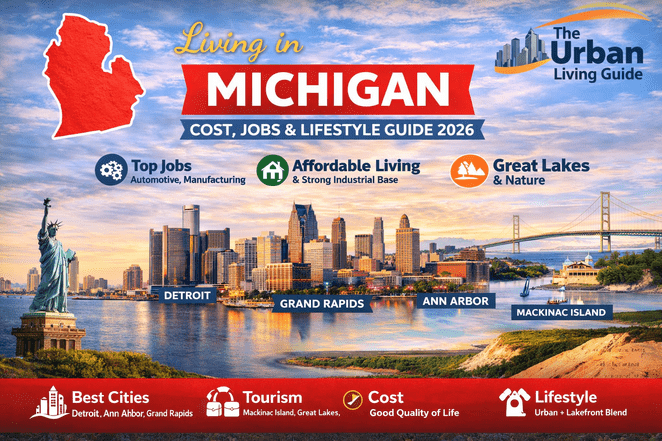
Living in Michigan: Automotive Heritage, Great Lakes Wilderness, and Industrial Resurgence in 2026
Making your home in Michigan in 2026 means settling into a culturally rich and geographically diverse state spanning over 96,716 square miles, bordered by four of the five Great Lakes and featuring one of the longest freshwater coastlines in the world. As a long-term local resident will tell you, the Great Lakes State offers a striking balance between the high-velocity, tech-driven automotive corridors of Metro Detroit and the slower, storied pace of the Upper Peninsula’s rugged wilderness.
From the innovative academic centers of Ann Arbor and the booming economic revitalization of Grand Rapids to the maritime heritage of the Great Lakes, everyday life here is characterized by deep industrial roots, a population of approximately 10 million residents, and a resilient economy anchored by manufacturing, healthcare, and rapidly growing technology sectors. For official administrative guidelines, state tax filings, and civic resources, residents frequently consult the Official State of Michigan Portal.
| Quick Facts Snapshot: Michigan (2026) | |
|---|---|
| Time Zone | Eastern Time Zone (ET / UTC-5, Daylight Saving UTC-4) |
| State Population | Approx. 10 Million (Tenth-most populous state in the U.S.) |
| State Income Tax | Flat individual income tax rate of 4.25% |
| Median Home Price | $230,000 – $350,000+ (Varies significantly between Metro Detroit/Ann Arbor and rural northern counties) |
| Average Rent Range | $1,100 – $2,100+ per month (Dependent heavily on urban density vs. rural accessibility) |
| Sales Tax Baseline | 6.0% state-wide base with no local option surtaxes |
What It Is Really Like to Live Here (The Macro Reality & Cultural Identity)
Living across the Great Lakes State requires mastering a lifestyle defined by its profound industrial legacy and an unrivaled connection to freshwater nature. Locals quickly understand that day-to-day existence depends entirely on whether your zip code sits within the high-velocity manufacturing heartland or the serene, four-season wilderness that characterizes the northern regions. The state thrives on the cooperation between its historic “Motor City” past and its hyper-modern focus on autonomous vehicle engineering, green energy, and life sciences. Gain deeper insights into regional heritage and tourism planning at Michigan.org.
- Geographic Reach: Spanning from the industrialized Detroit River waterfronts to the pristine glacial lakes of the Upper Peninsula and the diverse shoreline of Lake Michigan.
- Economic Identity: A stable, reinventing economy anchored by the Big Three automotive giants, cutting-edge engineering startups, world-class medical systems, and a massive agricultural footprint.
- Cultural Heritage: A sophisticated blend of midwestern values, deep automotive innovation roots (centered around Dearborn and Detroit), university-town intellectualism (like Ann Arbor), and a deep-seated love for outdoor recreation in the Great Lakes.
Regional Diversity, Geography & Economic Zones
Because Michigan is bisected by the Straits of Mackinac into two massive peninsulas, its geography creates two entirely different living experiences, housing markets, and community frameworks.
Coastal Corridors, Metro Hubs & Suburban Enclaves
- Southeast Michigan (Metro Detroit): Encompassing Detroit, Troy, and Ann Arbor—serving as the state’s global economic anchor, financial hub, and high-tech manufacturing center.
- West Michigan (The Lakeshore): Centered around Grand Rapids and Kalamazoo, characterized by a booming manufacturing base, world-class healthcare networks, and direct access to Lake Michigan beaches.
- Mid-Michigan (The Capital Belt): Anchored by Lansing and East Lansing, balancing government administration with a massive university-student population.
Mountain, Inland, Agricultural & Resource Belts
- The Upper Peninsula (The U.P.): A massive, sparsely populated wilderness zone defined by rugged forests, mining history, the Lake Superior shoreline, and a tourism-heavy seasonal economy.
- The Thumb & Saginaw Bay: An agricultural-heavy region focusing on sugar beet farming, manufacturing heritage, and small-town commerce along Lake Huron.
- Inland Recreation Zones: Massive protected forest areas such as Huron-Manistee National Forest, providing thousands of miles of hiking, snowmobiling, and pristine freshwater fishing.
Infrastructure, Power Grids, Water Systems & Transport Networks
Sustaining 10 million residents in a state surrounded by freshwater demands sophisticated engineering projects, extensive electrical grids, and a high-demand transport network.
Water Resources, Aqueducts & Watersheds
- The Great Lakes Basin: Managing the world’s largest freshwater system is a state-wide priority, critical for municipal drinking water, heavy industrial processing, and commercial shipping. Learn more via the Michigan Department of Environment, Great Lakes, and Energy.
Power Generation & Clean Energy Frameworks
- Diverse Grid Mix: Electrical infrastructure is managed by major investor-owned utilities like DTE Energy and Consumers Energy, utilizing a significant mix of nuclear generation, natural gas, and increasing utility-scale wind and solar investments.
Statewide Transit, Rail, Air & Port Connectivity
- Global Aviation: International travel is anchored by Detroit Metropolitan Airport (DTW), one of the nation’s busiest travel hubs, supported by Gerald R. Ford International Airport in Grand Rapids.
- Road & Rail: Critical logistics movement relies on massive freight rail networks and the I-75, I-94, and I-96 highway arteries that connect the Midwest to global export markets via Canada.
Statewide Economy, Job Markets & Major Industries
Michigan maintains a towering macroeconomic footprint, serving as the global nerve center for automotive innovation and advanced manufacturing.
- GDP Powerhouse: Consistently generating massive economic output, cementing Michigan as a premier authority in global engineering and industrial production.
- Dominant Sectors: Advanced automotive/EV manufacturing, mobility software, healthcare research, biotechnology, and agricultural food processing.
- Corporate Footprint: Headquarters for multi-national giants such as Ford Motor Company, General Motors, Stellantis, Dow Inc., and Whirlpool. Track state economic development initiatives via the Michigan Economic Development Corporation.
Salary Realities Across Economic Corridors
- Metropolitan Earning Potential: High-level automotive engineering, executive management, and healthcare research roles in the Detroit metro area command average professional salaries well above national medians, frequently exceeding $120,000 to $180,000+.
- Regional Wage Variance: Manufacturing and service wages in western and rural Michigan align closer to national medians, balanced by lower cost-of-living thresholds outside the immediate metro commuter radii.
Cost of Living Realities & Housing Market Variance
Living in Michigan requires strategic budget planning, as expenses vary from incredibly affordable housing markets in revitalizing cities like Detroit to higher-demand real estate in college towns like Ann Arbor.
| Expense Category | Cost Range / Index Reality |
|---|---|
| Housing (Urban vs. Rural) | $1,200–$2,000+ monthly rent in metro centers; $800–$1,400 in regional hub cities |
| Utilities & Heating | Above average in winter, driven by severe northern climate heating demands |
| Transportation | Significant focus on reliable personal vehicle ownership and maintenance |
| Groceries & Goods | Aligns very closely with national medians across all regions |
State Tax Climate, Business Environment & Government Policies
Michigan operates under a predictable, pro-business regulatory model characterized by flat income taxation and strong industrial incentives. Review tax compliance guidelines via the Michigan Department of Treasury.
- Income Tax Structure: Imposes a flat individual income tax rate of 4.25%, simplifying household tax planning.
- Property Tax Pressures: Local school districts and county governments rely heavily on property assessments, making tax planning essential before purchasing.
- Regulatory Framework: Comprehensive manufacturing incentives, labor regulations supporting skilled trade work, and robust agricultural statutes shape local business compliance.
Legal & Lifestyle Governance Quirks
- Driver Licensing: New residents must transfer out-of-state driver’s licenses and register vehicles through the Michigan Secretary of State office.
- No-Fault Auto Insurance: Michigan maintains a unique no-fault automobile insurance mandate that significantly impacts annual premium structures for all vehicle owners.
Climate, Weather Extremes & Natural Geography
Michigan experiences a classic four-season humid continental climate marked by cold, snowy winters and warm, humid summers.
- Seasonal Variations: Northern regions and the Upper Peninsula experience harsh winters with heavy lake-effect snowfall, while southern regions enjoy slightly milder coastal-moderated winters.
- Environmental Realities: Residents maintain seasonal preparedness for deep freeze cycles, heavy lake-effect snowstorms, and severe spring thaw cycles.
- Natural Landmarks: From the massive dunes of Sleeping Bear to the pristine glacial lakes of the Upper Peninsula, the landscape defines the state’s character.
Insurance Cost Realities (Winter & Storm Risks)
- Winter Weather Exposure: Property insurance policies account for heavy snow load damage, ice damming, and pipe freeze claims during harsh months.
- Flood and Sewer Coverage: Properties situated near Great Lakes shorelines or major river basins often require supplemental flood insurance.
Education Systems & Major Healthcare Networks
Access to elite academic institutions and advanced medical complexes anchors Michigan’s intellectual and institutional prestige.
- Higher Education Framework: Home to world-renowned research universities including the University of Michigan, Michigan State University, and Wayne State University.
- Advanced Healthcare: Elite medical networks like Michigan Medicine (U-M), Corewell Health, and Henry Ford Health provide groundbreaking clinical care. Review public health standards via the Michigan Department of Health and Human Services.
- Public Education: School district quality varies, with highly-funded suburban districts consistently ranking among the best in the Midwest.
Culture, Outdoor Recreation & Lifestyle Shifts
Daily life in Michigan spans unmatched industrial innovation and pristine freshwater wilderness.
- Outdoor Living: Hiking in the Upper Peninsula, skiing at Boyne Mountain, boating on the Great Lakes, and visiting Mackinac Island form essential weekend routines.
- Culinary Heritage: Famed for diverse food scenes in Detroit, artisanal apple cider mills, and local breweries spanning the entire state. Explore statewide tourism via Michigan Department of Natural Resources.
Relocation & State Residency Essentials
- Driver’s License & Vehicle Registration: New residents must transfer out-of-state driver’s licenses and register vehicles through a Secretary of State (SOS) office.
- Voter Registration: Eligible citizens register through the Michigan Voter Information Center.
Major Counties and Rural Living Realities in Michigan
- Wayne County: The most populous, home to the industrial powerhouse of Detroit.
- Oakland County: A massive suburban and high-tech economic engine north of Detroit.
- Kent County: The vibrant Grand Rapids area, known for manufacturing and healthcare.
- Washtenaw County: The educational and intellectual hub surrounding Ann Arbor.
Major Regional Hubs and Cities to Explore
Major Urban Hubs and Economic Centers at a Glance
| City / Hub | Primary Economic Driver | Vibe & Lifestyle Profile |
|---|---|---|
| Detroit | Automotive, Tech, Arts | Revitalized urban core, deep industrial heritage, energetic |
| Grand Rapids | Healthcare, Manufacturing | Fast-growing, family-oriented, scenic |
| Ann Arbor | Higher Education, Tech | Academic, innovative, walkable |
| Lansing | Gov, Education | Stable, state capital, balanced |
| Flint | Redevelopment | Affordable, industrially focused |
Detailed Breakdown of Key Regional Hubs and Cities
Detroit — The Global Automotive Epicenter
As the “Motor City,” Detroit serves as the primary urban engine of Michigan. Life revolves around aggressive economic redevelopment, a thriving arts culture, and an evolving cityscape that blends industrial history with new tech innovation.
Grand Rapids — The Healthcare and Manufacturing Hub
Positioned in West Michigan, Grand Rapids balances a robust manufacturing base with world-class healthcare centers and universities, making it highly desirable for families.
Ann Arbor — The Academic and Intellectual Enclave
Anchored by the University of Michigan, Ann Arbor offers a high-tech, innovative, and walkable community with excellent education and cultural amenities.
Lansing — The Historic State Capital
Lansing anchors the mid-state region with government stability, providing a pragmatic, balanced environment for civil servants and students.
Flint — The Resilient Industrial City
Flint is known for its resilient industrial heritage and ongoing redevelopment efforts, providing an incredibly affordable entry point for housing.
Pros and Cons of Making Michigan Your Home
| Advantages (Pros) | Systemic Drawbacks (Cons) |
|---|---|
| Extremely affordable housing markets compared to the national average | Harsh, long winter months with significant lake-effect snow |
| Unrivaled access to freshwater and outdoor recreation | Urban economic disparities in certain municipal cores |
| Thriving global industrial, tech, and engineering job markets | Need for reliable car ownership outside dense city centers |
Frequently Asked Questions About Living in Michigan
Is Michigan a good state to live in?
Yes, especially if you prioritize affordability, access to nature, and career opportunities in automotive, healthcare, or engineering industries.
What is the actual cost of living in Michigan?
It is quite low compared to the national average, especially regarding housing prices, making it a highly attractive destination for families and first-time buyers.
Which region or city is best to settle down in?
It depends on your lifestyle goals: Ann Arbor for education, Grand Rapids for family living and healthcare careers, and the Metro Detroit suburbs for corporate employment opportunities.
Does Michigan have high taxes?
The state income tax is a flat 4.25%, which is competitive, though local property taxes are necessary to fund schools and municipal services in suburban areas.
How safe is everyday life across the state?
Safety varies significantly by region; Michigan’s suburban and small-town areas consistently rank among the safest places to live, while urban centers require standard metropolitan awareness.
What industries dominate Michigan’s job market?
Automotive manufacturing and engineering, life sciences and healthcare, higher education, and logistics drive the state’s economy.
What is the weather like across the state?
Michigan experiences four distinct seasons, including humid, warm summers and cold, snowy winters that vary significantly by latitude and lake proximity.
Explore Detailed City Guides Across Michigan
At The Urban Living Guide, our core mission is to provide deeply researched regional insights and city-level navigation tools to help you evaluate your relocation options with total confidence. To discover what daily life, housing patterns, and local economies look like across our featured municipal centers throughout the Great Lakes State, explore our comprehensive resident hub guides below:
- Living in Detroit, Michigan
- Living in Grand Rapids, Michigan
- Living in Ann Arbor, Michigan
- Living in Lansing, Michigan
- Living in Flint, Michigan
Whether you are comparing career prospects in the automotive corridor or evaluating lifestyle shifts near the Great Lakes, our editorial team remains dedicated to delivering research-backed, data-driven frameworks to support your relocation and residency decisions with complete clarity.