

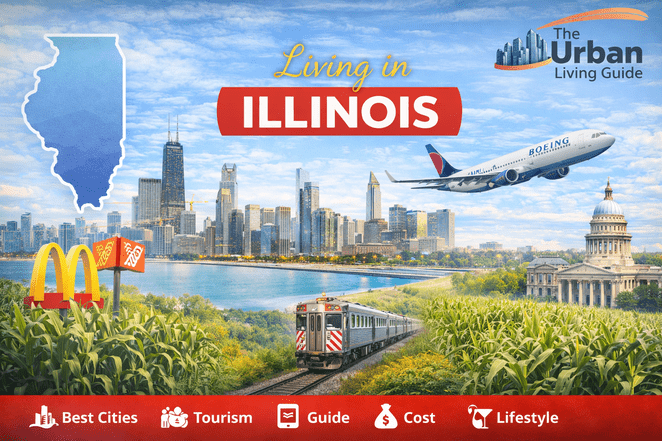
Living in Illinois: Great Lakes Shorelines, Prairie Heritage, and Chicago Metropolis Realities in %currentyear%
Making your home in Illinois in %currentyear% means settling into a powerhouse Midwestern landscape spanning over 57,914 square miles, bordered by the mighty Mississippi River to the west, the Ohio River to the south, and the urban freshwater shores of Lake Michigan to the northeast. As a long-term local resident will tell you, the Prairie State is a study in contrasts: it pairs the high-speed financial and cultural engine of Chicago with vast, flat agricultural plains and historic small towns. From the architectural canyons of the Loop to the rolling cornfields of the central plateau and the forested bluffs of the southern Shawnee Hills, everyday life here is defined by immense geographic variety, a population of approximately 12.4 million residents, and a resilient identity shaped by industrial innovation and agricultural tradition. For official administrative guidelines, tax filings, and civic updates, residents frequently consult the Official State of Illinois Portal.
| Quick Facts Snapshot: Illinois (%currentyear%) | |
|---|---|
| Time Zones | Central Time Zone (CT / UTC-6, Daylight Saving UTC-5) |
| State Population | Approx. 12.4 Million (Sixth-most populous state in the U.S.) |
| State Income Tax | 4.95% flat tax rate structure assessed on net income |
| Median Home Price | $260,000 – $340,000 (Varies heavily between Chicagoland suburbs and rural southern counties) |
| Average Rent Range | $1,200 – $2,200+ per month (Dependent on neighborhood and transit proximity) |
| Sales Tax Baseline | 6.25% state base, with local municipal and county surtaxes pushing combined rates between 7.25% and 11.5% |
What It Is Really Like to Live Here (The Macro Reality & Cultural Identity)
Living across the Prairie State requires mastering the balance between fast-paced metropolitan efficiency and steady, family-oriented Midwestern values. Locals quickly learn that life here depends entirely on whether your daily rhythm revolves around urban commuter trains or rural county highways.
- Cultural Vibe: A powerful blend of world-class urban sophistication, rich blues and jazz musical heritage, and blue-collar industrial grit that anchors Midwestern community life.
- Pace of Life: Highly polarized—ranging from the high-energy, transit-driven hustle of Chicago and its collar counties to the quiet, community-centric rhythm of central farming towns.
- The Resident Trade-Off: Long-term locals accept rigorous winter weather and higher-than-average property tax burdens in exchange for central U.S. logistics access, robust career mobility, and relatively affordable housing outside the immediate Chicago core.
Regional Diversity, Geography & Economic Zones
Because Illinois stretches nearly 400 miles from north to south, its geography encompasses distinct regional zones that shape completely separate daily living environments.
Coastal Corridors, Metro Hubs & Collar Counties
- Chicagoland & Collar Counties: A massive metropolitan expanse anchored by Cook County, DuPage County, and Lake County, driving the financial, corporate, and technological core of the state.
- The Quad Cities & Northern Manufacturing Belt: Positioned along the Mississippi River around Rockford and the western border, focusing on advanced manufacturing, aerospace components, and heavy machinery.
- The Central Capital Region & Springfield: Anchored by state government administration, historic Lincoln sites, and educational institutions surrounded by fertile crop fields.
Prairie Plains, River Valleys & Southern Hills
- The Central Cash-Grain Plains: Flat, highly fertile prairie terrain dedicated to intensive corn and soybean production across counties like Sangamon County and McLean County.
- The Southern Shawnee Hills: Rugged, forested uplands near the confluence of the Mississippi and Ohio rivers, offering state parks, local wineries, and a distinct southern-influenced lifestyle.
Infrastructure, Power Grids, Water Systems & Transport Networks
Sustaining over 12 million residents and serving as the primary transportation gateway of the United States requires extensive water engineering, independent energy grids, and massive transit corridors.
Water Resources, Rivers, Canals & Lake Michigan
- Lake Michigan & River Basins: The state relies heavily on Lake Michigan for municipal water supply, supported by major inland river basins including the Illinois River, Rock River, and Kaskaskia River.
- Engineering Marvels: The historic Chicago Sanitary and Ship Canal reversed the flow of the Chicago River, safeguarding the city’s drinking water supply. Review environmental regulations via the Illinois Environmental Protection Agency.
Power Generation & Nuclear Energy Capacity
- Nuclear Power Leadership: Electricity is supplied largely by ComEd and Ameren Illinois, with Illinois ranking as a national leader in nuclear power generation through commercial plants like the Braidwood and Byron generating stations.
- Renewable Expansion: State legislation continues to accelerate utility-scale wind and solar energy capacity across rural open spaces.
Statewide Transit, Rail, Air & Port Connectivity
- Global Aviation Core: International and domestic travel is anchored by world-class passenger hubs including Chicago O’Hare International Airport and Midway International Airport.
- Rail & Interstate Grid: Serving as the nation’s premier rail and freight crossroads, supported by heavy interstate arteries such as I-90, I-55, I-80, and I-57.
- Public Transit Infrastructure: Commuter transit networks like Metra rail and Pace buses connect Chicagoland suburbs directly to downtown Chicago employment centers.
Statewide Economy, Job Markets & Major Industries
Illinois boasts a highly diversified, multi-sector economy that anchors the financial and industrial strength of the American Midwest.
- GDP Powerhouse: Generating robust economic output that consistently positions Illinois among the top ten state economies in the United States.
- Dominant Sectors: Financial services, futures trading, advanced manufacturing, food processing, healthcare administration, logistics, and corporate management.
- Corporate Footprint: Global headquarters for major corporations such as United Airlines, McDonald’s, Caterpillar, and Abbott Laboratories. Track state business development data via the Illinois Department of Commerce and Economic Opportunity.
Salary Realities Across Economic Corridors
- Metropolitan Earning Potential: Corporate leadership, finance, and specialized engineering positions in Chicago and collar counties offer high professional salaries, frequently exceeding $100,000 to $160,000 for experienced managers.
- Regional Wage Variance: Wages in central and southern agricultural counties align closer to regional manufacturing and farming pay scales, balanced by significantly lower housing and living costs.
Cost of Living Realities & Housing Market Variance
Illinois offers a moderate overall cost of living that shifts dramatically depending on whether you reside within the Chicago metropolitan footprint or rural agricultural counties.
- Housing Market Index: While downtown Chicago and affluent collar-county suburbs (like Naperville) feature competitive real estate prices, smaller cities like Rockford, Peoria, and Springfield offer highly accessible homeownership thresholds.
- Utility Expenses: Severe winter temperatures lead to high residential heating demands, resulting in seasonal spikes in monthly natural gas and electric bills.
- Tax Burdens: High property tax assessments and sales taxes offset some of the savings gained from moderate housing costs.
| Expense Category | Cost Range / Index Reality |
|---|---|
| Housing (Chicagoland vs. Downstate) | $350,000 – $600,000+ in Chicago and collar suburbs; $150,000 – $260,000 in downstate regional cities |
| Utilities & Heating | Above national averages during winter months due to intense residential heating and natural gas consumption |
| Transportation & Fuel | Moderate fuel pricing, though toll road networks and public transit fares add to monthly travel budgets in the north |
| Groceries & Goods | Close to national benchmarks, supported by regional supermarket distribution networks |
State Tax Climate, Business Environment & Government Policies
Illinois operates under a fiscal framework characterized by a flat income tax structure alongside high local property tax assessments used to fund municipal services.
- Flat Income Tax System: Enforces a flat state income tax rate of 4.95% across all taxable personal income brackets, simplifying individual state return filing. Review tax guidelines at the Illinois Department of Revenue.
- Property Tax Assessments: Managed locally by individual counties, resulting in effective property tax rates that rank among the highest nationwide, heavily funding local public school districts.
- Business Regulations: Standard corporate income taxes and compliance frameworks governed by pro-growth economic development incentives for targeted manufacturing and tech sectors.
Legal & Lifestyle Governance Quirks
- Home Rule Powers: Broad legal authority granted to local municipal governments to enact specific zoning ordinances, local sales taxes, and residential codes.
- Open Meetings & Freedom of Information: Strict statutory transparency laws guaranteeing public access to government agency records and open municipal council meetings.
- Vehicle Registration Deadlines: Legal requirements mandating that new residents transfer vehicle titles and obtain an Illinois driver’s license within 30 days of moving.
Climate, Weather Extremes & Natural Geography
Illinois experiences a classic continental climate featuring four distinct seasons marked by cold winters, warm summers, and notable weather volatility.
- Seasonal Variations: Winters are cold and snowy, with northern regions experiencing lake-effect snows from Lake Michigan. Summers are warm and humid, with temperatures frequently rising above 85°F to 90°F.
- Environmental Realities: Residents must maintain active preparedness for winter blizzards, freezing rain, spring severe thunderstorm activity, and occasional Midwest tornado risks.
- Natural Landmarks: From the towering sandstone canyons of Starved Rock State Park to the rolling hills of the Mississippi Palisades, outdoor recreation is anchored by unique geological formations.
Insurance Cost Realities (Winter & Storm Risks)
- Winter Weather Claims: Homeowner insurance policies must account for risks associated with heavy snow loads, frozen pipe bursts, and ice damming during harsh winter months.
- Severe Storm Deductibles: Property coverage often includes specialized wind and hail deductibles due to frequent spring and summer severe thunderstorm systems crossing the Midwest.
- Flood and Sewer Backups: Properties in low-lying river valleys or urban basement configurations frequently require supplemental flood or sewer backup insurance endorsements.
Education Systems & Major Healthcare Networks
Access to world-class research universities and advanced medical complexes forms a foundational pillar of Illinois’s intellectual and physical infrastructure.
- Higher Education Framework: Home to elite global institutions including the University of Chicago, University of Illinois Urbana-Champaign, and Northwestern University.
- Advanced Healthcare: Anchored globally by premier medical systems in Chicago, including Northwestern Medicine and Rush University Medical Center, providing elite clinical care. Review public health standards via the Illinois Department of Public Health.
- Public Education Variance: Public school district performance varies by local property tax revenue, with top-tier suburban districts in counties like DuPage County earning exceptional national ratings.
Culture, Outdoor Recreation & Lifestyle Shifts
Daily life in Illinois blends sophisticated urban arts and culinary traditions with classic Midwestern outdoor recreation.
- Outdoor Living: Boating on Lake Michigan, hiking through state parks along the Illinois River, and cycling down extensive regional trail networks form regular weekend routines.
- Culinary Heritage: Famed worldwide for Chicago-style deep-dish pizza, iconic Italian beef sandwiches, dynamic neighborhood food festivals, and craft breweries.
- Sports & Entertainment: A deeply passionate sports culture supporting iconic professional franchises (NFL, MLB, NBA, NHL, MLS) alongside world-class museums and theater districts. Explore statewide tourism through Enjoy Illinois.
Relocation & State Residency Essentials
Establishing official legal residency in Illinois involves straightforward administrative procedures that secure your state-level civic rights and tax standing.
- Driver’s License Transfer: New residents are legally required to visit an Illinois Secretary of State facility to obtain a state driver’s license within 30 days of moving.
- Vehicle Titling & Registration: Motor vehicles must be titled and registered with the state, including mandatory emissions testing for vehicles registered in Chicagoland and Metro East counties.
- Voter Registration: Eligible citizens can register to vote %currentyear% online or through local county clerk offices to participate in upcoming municipal and federal elections.
Major Counties and Rural Living Realities in Illinois
Beyond the gleaming downtown towers of Chicago, Illinois’s powerful county administrative units and agricultural heartlands shape distinct regional communities.
- Cook County: The most populous county in the state, housing Chicago and serving as the primary economic, legal, and financial core of the Midwest.
- DuPage County: A prosperous suburban county west of Chicago known for exceptional public schools, master-planned commercial centers, and safe neighborhoods.
- Lake County: Encompassing suburban communities and scenic lakefront districts along the Wisconsin border, balancing corporate campuses with natural preserves.
- Rural and Agricultural Living: Central and southern rural counties provide a peaceful, highly affordable lifestyle centered around family farming, local harvest festivals, and close-knit small-town traditions.
Major Regional Hubs and Cities to Explore
Major Urban Hubs and Economic Centers at a Glance
| City / Hub | Primary Economic Driver | Vibe & Lifestyle Profile |
|---|---|---|
| Chicago | Finance, Trade, Culture, Tech | Global metropolis, stunning architecture, diverse neighborhoods, transit-heavy core |
| Springfield | State Government, Public Administration | Historic Lincoln capital, slower pace of life, highly stable public-sector economy |
| Naperville | Suburban Commerce, Family Living | Top-tier public schools, safe master-planned neighborhoods, thriving local retail |
| Aurora | Manufacturing, Logistics, Healthcare | Growing Fox River city, diverse communities, accessible housing value |
| Rockford | Aerospace Manufacturing, Engineering | Industrial roots, riverfront parkways, affordable housing options |
Detailed Breakdown of Key Regional Hubs and Cities
Chicago — The Global Architectural and Financial Metropolis
Stretching along the dramatic waterfront of Lake Michigan, Chicago serves as the economic and cultural titan of the Midwest. Life here revolves around world-class financial exchanges, diverse ethnic neighborhoods, iconic theater districts, and navigating an efficient transit-oriented urban grid.
Springfield — The Historic State Capital
Steeped in Abraham Lincoln history and government administration, Springfield offers a classic Midwestern capital city experience. Residents enjoy tree-lined historic residential districts, a relaxed pace of life, and a highly stable public-sector job market.
Naperville — The Premier Family Suburban Center
Consistently ranked among the best places to live in the United States, Naperville pairs exceptional public school systems with a vibrant, walkable downtown riverwalk area. It provides an upscale, safe suburban environment with direct commuter rail access to Chicago.
Aurora — The Growing Fox River Innovation Hub
Spanning across four counties along the Fox River, Aurora offers a blend of historic manufacturing architecture and rapid modern suburban growth. It provides diverse residential communities, accessible housing markets, and strong local employment corridors.
Rockford — The Forest City Manufacturing Center
Positioned along the Rock River in northern Illinois, Rockford maintains a proud industrial and aerospace manufacturing heritage. It features scenic forest preserves, cultural museums, and a highly cost-effective real estate market.
Pros and Cons of Making Illinois Your Home
| Advantages (Pros) | Systemic Drawbacks (Cons) |
|---|---|
| Strong, diversified job market anchored by Chicago’s corporate core | High property tax assessments across municipal districts |
| Central U.S. geographic location with unmatched transit connectivity | Cold, demanding winter weather and seasonal snowfall extremes |
| Affordable housing options and great value in downstate cities | Higher cost of living and traffic congestion within the Chicago metro |
| World-class higher education institutions and advanced medical networks | Economic disparities and safety challenges in specific urban pockets |
Frequently Asked Questions About Living in Illinois
Is Illinois a good state to live in?
Yes, especially for professionals seeking strong career opportunities, excellent transport connectivity, and access to a major global city, provided you budget for higher property tax rates.
What is the actual cost of living in Illinois?
It sits close to the national average overall, with Chicago and its collar counties demanding higher expenses while downstate regional cities offer budget-friendly living.
Which region or city is best to settle down in?
It depends entirely on your lifestyle goals: Chicago for urban professionals, Naperville for families seeking elite schools, Springfield for government careers, and Rockford for housing value.
Does Illinois enforce high taxes?
Yes, while the state maintains a flat 4.95% income tax rate, local property taxes rank among the highest in the nation to fund public infrastructure and school districts.
How safe is everyday life across the state?
Safety levels vary significantly by municipality; collar-county suburbs and smaller downstate towns offer exceptional security, while specific urban neighborhoods require standard metropolitan awareness.
What industries dominate Illinois’s job market?
Financial services, corporate management, advanced manufacturing, healthcare, logistics, and agricultural production drive ongoing statewide employment.
What is the weather like across the state?
Winters are cold with heavy snow and lake-effect storms in the north, while summers are warm and humid, creating true four-season weather variations.
How do residency rules impact my vehicle and license?
New residents must transfer out-of-state driver’s licenses and register their motor vehicles within 30 days of establishing primary residency in Illinois.
What should I know about Illinois property taxes?
Property taxes are assessed locally by counties and municipalities, making it crucial to research specific local millage rates when evaluating real estate purchases.
Explore Detailed City Guides Across Illinois
We have compiled comprehensive resources and detailed guides to help you understand what daily living feels like across different urban hubs and regional centers throughout the state.
- Living in Chicago, Illinois
- Living in Springfield, Illinois
- Living in Naperville, Illinois
- Living in Aurora, Illinois
- Living in Rockford, Illinois
At The Urban Living Guide, our mission is to deliver research-backed, data-driven insights, lifestyle breakdowns, and practical guidance to help you navigate modern urban living decisions with complete clarity.