

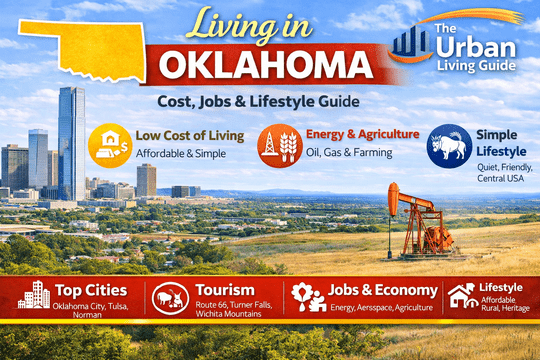
Living in Oklahoma: The Crossroads of America, Energy Stability & Open-Space Living in 2026
Establishing your life in Oklahoma in 2026 means tapping into the literal geographic and logistical center of the United States—a state spanning over 69,899 square miles that acts as the primary bridge between the industrial Midwest, the mountainous Rockies, and the sprawling Southern plains. As a long-term local resident will tell you, the Sooner State offers a compelling, pragmatic living proposition: it is a region where the cost-of-living index consistently stays below the national average, yet the economy is anchored by massive, global-scale operations in energy, aerospace, and logistics.
From the revitalized urban core of Oklahoma City and the sophisticated arts-and-finance districts of Tulsa to the rugged, forested hills of the Ozark transition zones, everyday life here is characterized by an unpretentious pace, an aggressive pro-business tax framework, and a unique cultural fusion of Western cowboy legacy and Native American historical depth. Whether you are navigating the high-speed distribution arteries that make this state a national logistics hub or enjoying the quiet, expansive nature of the Wichita Mountains, life in Oklahoma offers a stability that is increasingly rare in more volatile coastal markets. For official administrative guidelines, state tax filings, and civic resources, residents frequently consult the Official State of Oklahoma Portal.
| Quick Facts Snapshot: Oklahoma (2026) | |
|---|---|
| Time Zone | Central Time Zone (CT / UTC-6, Daylight Saving UTC-5) |
| State Population | Approx. 4 Million (Strong growth concentrated in OKC and Tulsa metro hubs) |
| State Income Tax | Flat individual income tax rate of 4.75% (with clear paths for future reductions) |
| Median Home Price | $210,000 – $320,000+ (Extreme divergence between urban OKC and rural panhandle counties) |
| Average Rent Range | $950 – $1,600+ per month (Dependent on downtown urban density) |
| Sales Tax Baseline | 4.5% state base, with local city and county additions pushing combined totals between 7% and 9.5% |
What It Is Really Like to Live Here (The Macro Reality & Cultural Identity)
Living across the Sooner State requires mastering a lifestyle that blends rugged, frontier-era heritage with a modern, high-tech pivot. Locals quickly recognize that day-to-day existence depends entirely on your specific economic region: Central Oklahoma is the administrative and tech-driven heart, Northeast Oklahoma is the historic oil and banking cradle, and the rural expanses remain the backbone of the state’s massive agricultural output. Unlike states defined by singular tourism-based economies, Oklahoma thrives on the interplay between its traditional energy sector and an emerging, diversified tech ecosystem.
Long-term residents value the personal freedom and financial bandwidth that the state’s low-tax environment provides, even while acknowledging the need for proactive storm-preparedness and weather-conscious architecture. Explore regional heritage and tourism planning via the Oklahoma Tourism & Recreation Department.
- Cultural Vibe: A powerful melting pot driven by Western cowboy traditions, deep-seated Native American sovereign heritage, and an increasingly sophisticated arts and dining scene in the metro cores.
- Pace of Life: Distinctly balanced—ranging from the high-velocity corporate rhythm of Oklahoma City’s downtown financial sector to the quiet, community-focused pace of suburban neighborhoods in Norman or Broken Arrow.
- The Resident Trade-Off: Newcomers accept the seasonal reality of spring storm activity and the need for private vehicle ownership in exchange for unmatched housing affordability and a tax structure that rewards high earners and small business owners alike.
Regional Diversity, Geography & Economic Zones
Because Oklahoma bridges the Great Plains and the Ozark Plateau, its geography encompasses starkly contrasting zones that dictate entirely separate daily living experiences.
Metro Corridors & The Front Range
- The Central Corridor (OKC/Norman): Encompassing the state capital and its rapidly expanding suburban satellites—serving as the primary hub for energy (oil/gas), healthcare administration, and the massive presence of Tinker Air Force Base.
- The Northeast Hub (Tulsa/Broken Arrow): A historic and revitalizing economic zone, historically anchored by energy and banking, now leading the state in manufacturing innovation, creative arts, and urban redevelopment.
Inland Plains, River Valleys & Resource Belts
- The Ozark Transition (Eastern Oklahoma): Features dramatic, hilly terrain and heavy forest cover, offering a vastly different aesthetic and outdoor recreational profile compared to the flat plains of the west.
- The Southern Plains: Large-scale agricultural zones focusing on high-volume beef production and essential crop output, providing a quiet, space-rich environment for rural residential living.
Infrastructure, Power Grids, Water Systems & Transport Networks
Sustaining the state’s growth requires sophisticated management of its massive river systems, energy-production infrastructure, and an integrated transit network.
Water Resources & Watersheds
- The Arkansas River System: A vital commercial and municipal water corridor. Conservation and supply management are handled by the Oklahoma Water Resources Board.
Power Generation & Energy Frameworks
- Grid Mix: Electricity is supplied primarily by OG&E and PSO, utilizing a massive portfolio of wind energy (the state is a national leader in wind capacity), natural gas, and coal-fired generation.
Statewide Transit, Rail, Air & Port Connectivity
- Aviation Gateways: International and domestic air travel is anchored by Will Rogers World Airport (OKC) and Tulsa International (TUL).
- Transit & Freight: Embark provides bus and streetcar transit for OKC, while the state serves as a national nexus for logistics, with massive freight-rail density and the critical I-35 and I-40 highway arteries.
Statewide Economy, Job Markets & Major Industries
Oklahoma’s economy has successfully moved past reliance on oil and gas alone, becoming a specialized hub for aerospace engineering and advanced distribution.
- Economic Footprint: Leveraging its central geographic location to reduce distribution friction for manufacturing and retail goods nationally.
- Dominant Sectors: Oil and natural gas extraction, aviation/aerospace, telecommunications, agriculture/livestock, and medical diagnostic manufacturing.
- Corporate Presence: Operational HQs for major enterprises such as Devon Energy, Chesapeake Energy, and expansive aerospace maintenance facilities. Track economic development via the Oklahoma Department of Commerce.
Salary Realities Across Economic Corridors
- Professional Potential: Technical roles in energy-sector management, aviation maintenance, and healthcare systems in the OKC/Tulsa metros command salaries that frequently exceed $75,000 to $120,000+ annually.
- Regional Wage Variance: Service, agricultural, and administrative wages in smaller county hubs align with lower local costs, often leading to very high relative purchasing power.
Cost of Living Realities & Housing Market Variance
Living in Oklahoma is fundamentally a value proposition. Even in high-demand pockets, housing affordability remains among the best in the U.S.
| Expense Category | Cost Range / Index Reality |
|---|---|
| Housing (Urban vs. Rural) | $1,300–$2,000+ monthly in OKC; $800–$1,300 in regional hub cities |
| Utilities | Stable; energy costs are among the lowest in the nation |
| Transportation | Car-centric; standard fuel and registration costs |
| Groceries & Goods | Consistently below national medians |
State Tax Climate, Business Environment & Government Policies
The state maintains a conservative, business-oriented fiscal policy designed to keep costs low and simplify compliance. Review official compliance instructions via the Oklahoma Tax Commission.
- Income Tax Structure: Features a simplified tax model that rewards earning and business investment.
- Property Tax Reality: Local assessments remain low compared to the U.S. average, keeping long-term overhead for homeowners very manageable.
Legal & Lifestyle Governance Quirks
- Driver Licensing: New residents must transfer out-of-state licenses and register vehicles through a Service Oklahoma office within 30 days of establishing residency.
- Open Government: Access to state agency documentation is provided via the state’s Sunshine Law statutes.
Climate, Weather Extremes & Natural Geography
Oklahoma’s climate is a classic humid subtropical environment, characterized by hot summers, mild winters, and significant seasonal shifts.
- Seasonal Variations: Summers are hot and humid, springs bring significant storm activity, and winters are typically short and temperate.
- Environmental Realities: Residents maintain high preparedness for seasonal storm activity, with nearly every residential property incorporating safety protocols.
- Natural Landmarks: From the rolling prairies of the Tallgrass Prairie National Preserve to the waterfall-filled ridges of Turner Falls Park.
Insurance Cost Realities (Disaster & Weather Risks)
- Storm Riders: Homeowners insurance must account for specific wind, hail, and storm damage riders due to the state’s position in the central weather-risk corridor.
Education Systems & Major Healthcare Networks
Education and healthcare have become central pillars of the state’s economic development. Explore state health metrics at the Oklahoma State Department of Health.
- Higher Education: Home to institutions including the University of Oklahoma and Oklahoma State University, which are key drivers of local innovation.
- Advanced Healthcare: Elite systems like OU Health and Integris Health provide specialized clinical care, with expanding networks supporting urban and suburban centers.
Culture, Outdoor Recreation & Lifestyle Shifts
Daily life revolves around community, local sports culture, and wide-open outdoor spaces. Explore recreation via Oklahoma State Parks.
- Outdoor Living: Fishing in Lake Eufaula, hiking the Wichita Mountains, and exploring the historic trails of Route 66.
- Arts & Entertainment: A rich cultural tapestry featuring local music festivals, professional sports teams, and vibrant, historic arts districts.
Relocation & State Residency Essentials
- Licensing: Secure your Oklahoma license/title at a Service Oklahoma branch within 30 days of the move.
- Voter Registration: Easily managed via the Oklahoma State Election Board.
Major Counties and Rural Living Realities in Oklahoma
- Oklahoma County: The urban hub, cultural, and political center of the state.
- Tulsa County: The historical industrial and commercial leader of the northeast.
- Cleveland County: A key educational and residential growth corridor.
Major Regional Hubs and Cities to Explore
Major Urban Hubs at a Glance
| City / Hub | Primary Driver | Vibe & Lifestyle Profile |
|---|---|---|
| Oklahoma City | Gov, Energy, Tech | Fast-growing, family-friendly, urban |
| Tulsa | Tech, Manufacturing | Artsy, historic, business-focused |
| Norman | Education | Collegiate, active, balanced |
| Broken Arrow | Commerce | Suburban, traditional, comfortable |
| Edmond | Suburban Growth | Upscale, professional, residential |
Detailed Breakdown of Key Regional Hubs
Oklahoma City — The Crossroads Urban Engine
As the state’s sprawling economic anchor, OKC provides immense career opportunities in aviation, healthcare, and finance. It offers a walkable downtown, professional sports, and a high-growth environment.
Tulsa — The Historic Cultural Anchor
Tulsa pairs deep energy-industry roots with a revitalized arts district and a burgeoning technology community. It provides a balanced, accessible city for those who appreciate architecture and regional culture.
Norman — The Academic and Research Gateway
Norman is anchored by the University of Oklahoma. It offers a community-focused atmosphere that attracts researchers, educators, and families seeking a stable suburban lifestyle.
Broken Arrow — The Family Residential Haven
A prime example of suburban growth, Broken Arrow provides an exceptional environment for families seeking larger housing footprints with easy freeway access to the broader Tulsa job market.
Edmond — The Upscale Suburban Alternative
Edmond offers a high-end suburban experience with excellent schools and a manicured community environment, serving as an increasingly popular residential choice for those working in the greater metro.
Pros and Cons of Making Oklahoma Your Home
| Advantages (Pros) | Systemic Drawbacks (Cons) |
|---|---|
| Extremely low cost of living and home pricing | Risk of seasonal severe weather/tornado activity |
| Zero state income tax potential (4.75% flat) | Lower public transit availability in suburban areas |
| Strong and stable community/family culture | Limited urban nightlife outside metro hubs |
| Accessible outdoor recreation and lakes | Healthcare service gaps in deep-rural zones |
| Central U.S. logistics and transit location | Professional wage caps in non-tech sectors |
Frequently Asked Questions About Living in Oklahoma
Is Oklahoma a good state to live in?
Yes, it is highly attractive for those seeking budget-friendly housing, tax efficiency, and a stable, family-oriented lifestyle in the heart of the Midwest.
What is the actual cost of living in Oklahoma?
It is consistently among the lowest in the nation, offering exceptional purchasing power for families and first-time homebuyers compared to nearly any other state.
Which region or city is best to settle down in?
It depends on your professional goals: Oklahoma City for corporate and tech expansion, Tulsa for its artistic/historic identity, and suburban hubs for school district quality.
Does Oklahoma have high taxes?
The state maintains a competitive, business-friendly tax model. While local sales taxes vary, the flat individual income tax makes financial planning predictable.
How safe is everyday life across the state?
Suburban and rural Oklahoma consistently rank as safe and quiet areas, while larger urban centers have localized crime trends similar to other major American metros.
What industries dominate Oklahoma’s job market?
Energy production (oil/gas), logistics and distribution, healthcare research, and aviation/aerospace manufacturing are the primary economic anchors.
What is the weather like?
The state experiences four distinct seasons with hot, humid summers and mild winters, plus a necessary focus on severe weather preparedness during the spring storm season.
Explore Detailed City Guides Across Oklahoma
At The Urban Living Guide (TULG), our core mission is to provide deeply researched regional insights and city-level navigation tools to help you evaluate your relocation options with total confidence. To discover what daily life, housing patterns, and local economies look like across our featured municipal centers throughout the Sooner State, explore our comprehensive resident hub guides below:
- Living in Oklahoma City, Oklahoma
- Living in Tulsa, Oklahoma
- Living in Norman, Oklahoma
- Living in Broken Arrow, Oklahoma
- Living in Edmond, Oklahoma
Whether you are comparing career prospects in the energy sector or evaluating lifestyle shifts in the heart of the Great Plains, our editorial team remains dedicated to delivering research-backed, data-driven frameworks to support your relocation and residency decisions with complete clarity.