

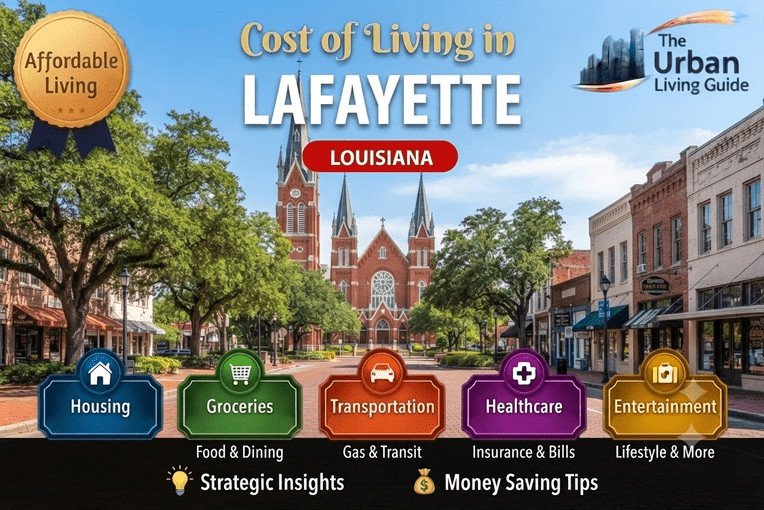
Cost of Living in Lafayette, Louisiana 2026: Hub City Economics, Oil Center Real Estate & Regional Affordability
Nestled in the heart of Acadiana along the Vermilion River, life in the City of Lafayette offers an irresistible blend of Cajun culture, world-class zydeco music, and a thriving energy and medical economy. While the local landscape is celebrated for its legendary hospitality, historic oak-lined streets, and vibrant culinary scene, managing monthly household expenditures in 2026 requires balancing the city’s highly accessible housing market against regional utility and insurance outlays. Whether you are relocating for energy sector engineering, higher education, or healthcare positions at Our Lady of Lourdes Regional Medical Center or Lafayette General Health, establishing a household across the historic Oil Center, upscale River Ranch, or family-friendly Bendel Gardens requires precise financial planning.
For incoming professionals, remote workers, and growing families planting roots across Lafayette Parish and neighboring Acadiana communities, understanding the true cost of living demands a clear-eyed look at market realities. When breaking down the cost of living in Lafayette, Louisiana during 2026, residents must account for intense summer air conditioning demands, heavy reliance on personal vehicle transit across Interstate 10 and U.S. Route 90, and everyday consumer costs shaped by regional supply chains. For official municipal services, zoning notices, and community resources, residents frequently consult the City of Lafayette Official Portal.
Average Monthly Expense Breakdown – Lafayette, Louisiana
Monthly expenses in Lafayette, Louisiana vary significantly depending on household size, lifestyle choices, and whether you choose to live within the urban core or suburban enclaves like Youngsville, Broussard, or Carencro. Below is a structured monthly financial breakdown displayed in a professional comparative table reflecting economic conditions in 2026:
| Expense Category | Single Adult | Couple | Family of 4 |
|---|---|---|---|
| Housing / Rent | $950 – $1,400 | $1,350 – $2,000 | $2,100 – $3,100 |
| Groceries & Food | $300 – $410 | $570 – $800 | $980 – $1,420 |
| Transportation & Commute | $125 – $245 | $250 – $460 | $410 – $760 |
| Utilities & Internet | $165 – $260 | $240 – $370 | $360 – $570 |
| Healthcare & Insurance | $135 – $310 | $310 – $660 | $620 – $1,250 |
| Childcare & Education | $0 | $0 | $1,050 – $2,100 |
| Entertainment & Leisure | $125 – $290 | $250 – $520 | $440 – $880 |
Local residents frequently note that while local festivals and Cajun dining offer unmatched cultural value, balancing regional insurance costs and summer electric adjustments requires structured household budgeting.
Watch this video to get a closer look at housing and neighborhood pricing in Lafayette, Louisiana.
Housing Costs, Real Estate & Neighborhood Dynamics in Lafayette, Louisiana
Housing represents an attractive financial commitment when evaluating the overall cost of living in Lafayette, Louisiana, presenting a diverse real estate market ranging from historic homes in the Oil Center to master-planned luxury developments in River Ranch. Rental inventory and acquisition pricing vary significantly across local districts, with municipal planning supported through the Lafayette Consolidated Government Planning Department.
- Downtown 1-BHK Apartments: Compact urban rentals near cultural districts range from $1,000 to $1,450/month.
- Suburban 1-BHK Apartments: Outlying residential areas near University of Louisiana at Lafayette (ULL) offer student and professional housing for $850 to $1,300/month.
- Family 3-BHK Rentals: Multi-bedroom houses in family-focused neighborhoods command $1,700 to $2,600/month.
- Real Estate Purchase Market: The median home price across Lafayette proper sits near $230,000 to $260,000, while upscale master-planned enclaves like River Ranch or verandah communities exceed $450,000 to $700,000.
Utilities & Bills Costs in Lafayette
Managing utility overhead in south Louisiana requires preparing for intense summer heat and high humidity, with electricity, water, and fiber internet services primarily handled by Lafayette Utilities System (LUS).
- Basic Monthly Utilities: Electricity, water, sewer, and waste services average $150 to $230/month during moderate spring and autumn months.
- Summer Air Conditioning Surges: When July and August temperatures exceed 95 degrees, running residential cooling units continuously pushes monthly electric bills to $220 to $350/month.
- Internet & Connectivity: High-speed municipal fiber broadband through LUS Fiber costs $50 to $85/month.
- Pest Control Services: Due to regional moisture and local insect activity, routine residential pest management runs $35 to $60/month.
Grocery and Food Costs in Lafayette
Grocery expenditures in the Lafayette metropolitan area track slightly below national averages while offering rich Acadian culinary options. Weekly provisions are commonly sourced from regional mainstays like Acadiana Farmers Market, Albertsons, or local specialty Cajun markets.
- Everyday Consumer Staples: A gallon of whole milk averages $3.15, a dozen large eggs runs $2.70, and local meat products remain reasonably priced.
- Farmers Markets: Shopping at local venues like the Lafayette Farmers Market at the Horse Farm (Moncus Park) helps budget-conscious residents secure fresh local produce and artisanal goods while cutting costs.
- Casual & Fine Dining: Casual mid-range meals featuring crawfish étouffée or boudin cost $12 to $21 per person, while fine dining establishments in River Ranch scale from $40 to $90+ per person.
Transportation and Commute Costs in Lafayette
Navigating the metropolitan area features heavy reliance on private motor vehicles, supplemented by public bus transit routes managed through Lafayette Transit System (City Transit).
- Public Transit Fares: Single-ride bus fares cost $1.25, day passes run $3.00, and monthly transit passes are available for $45.00.
- Fuel & Vehicle Operation: Regular unleaded gasoline hovers around $2.65 to $3.05 per gallon. Monthly fuel expenditures average $135 to $250 depending on daily commute distances.
- Car Insurance: Full-coverage auto insurance in Louisiana ranks among the highest nationwide, ranging from $1,850 to $2,800 annually.
- Downtown Parking: Securing a monthly parking garage pass downtown or near business hubs costs $75 to $140/month.
Healthcare Costs in Lafayette
Healthcare outlays remain competitive relative to national benchmarks, anchored by premier medical networks like Our Lady of Lourdes Regional Medical Center, Lafayette General Health, and Women’s & Children’s Hospital.
- Doctor Consultations: Standard general practitioner co-pays run $25 to $45, while specialist visits range from $50 to $75.
- Health Insurance Premiums: Individual marketplace health insurance plans average $295 to $530/month depending on coverage tiers.
Educational Frameworks, Daycare Pricing & Academic Excellence in Lafayette, Louisiana
Educational planning across Lafayette Parish involves navigating public school clusters, magnet programs, and respected private institutions anchored by regional higher education centers:
- Higher Education Anchor: Home to the University of Louisiana at Lafayette (ULL), providing exceptional research programs, collegiate sports culture, and employment density.
- Infant Daycares & Childcare: Full-time infant daycares and early learning facilities typically range between $900 and $1,550 per month per child across the metropolitan area.
- Preschool Programs: Structured private and parochial preschool programs average $620 to $1,200 per month.
- Private & College-Preparatory Academies: Respected local private institutions command annual tuitions ranging from $8,000 to $17,500+.
Entertainment & Lifestyle Costs in Lafayette, Louisiana
Recreational opportunities span cultural festivals, live music venues, shopping districts like River Ranch, and expansive park systems:
- Fitness & Recreation: Commercial gym memberships, multi-sport training facilities, and boutique fitness clubs average $40 to $90/month. Popular local training hubs include Red’s Leris Fitness and regional athletic clubs.
- Outdoor Leisure & Parks: Enjoying green spaces, walking trails, and athletic complexes managed by Lafayette Parish Parks and Recreation (LPSS) across locations like Moncus Park and Girard Park incurs minimal monetary cost beyond nominal activity fees.
- Cultural & Leisure Events: Attending performances at the Heymann Performing Arts Center, exploring Acadian Village, or attending festival international adds $30 to $80 per outing.
- Dining & Nightlife Outings: Enjoying local weekend entertainment, social gatherings, and live music venues across downtown or River Ranch averages $125 to $290 monthly for single adults and up to $520 monthly for couples.
Pet-Related Living Costs in Lafayette
Caring for dogs and cats across local neighborhoods involves steady monthly outlays:
- Veterinary Care: Routine wellness exams and preventative medications run $45 to $90/month across local veterinary clinics.
- Pet Supplies & Grooming: Premium pet food, toys, and grooming services add $45 to $105/month.
City-Specific Living Costs in Lafayette
Evaluating the broader economic profile of the cost of living in Lafayette, Louisiana shows an overall index sitting approximately 6% to 8% lower than the national average. While significant savings are realized in housing compared to major coastal hubs, unique regional expenses require balanced financial planning:
- Flood Insurance & Drainage Maintenance: Properties located near local bayous or low-lying flood zones require specialized flood insurance policies, adding annual overhead depending on elevation certificates.
- Severe Weather Preparation: Storm readiness requires investing in emergency generators, severe weather kits, and property tree maintenance during storm seasons.
- Parish Tax Variations: Navigating property assessments requires understanding distinct millage rates across Lafayette Parish versus neighboring Acadiana parishes.
Taxes in Lafayette, Louisiana
Tax structures in Lafayette, Louisiana during 2026 impact overall financial planning:
- State Income Tax: Louisiana utilizes a progressive personal income tax structure with top marginal rates capped at 4.25%.
- Property Taxes: Lafayette Parish maintains property tax assessments that support public infrastructure and school districts, moderated partially by homestead exemptions for primary homeowners.
- Sales Tax: Combined state and local sales taxes within Lafayette stand near 9.95%, supporting local municipal services.
Annual & Yearly Expenses in Lafayette
Comprehensive budgeting requires accounting for recurring annual and yearly non-housing expenses across the metropolitan area:
- Insurance & Licensing: Automotive insurance totals $1,850 to $2,800 yearly, alongside state vehicle registration fees of $40 to $80.
- Property Protection: Homeowners and windstorm insurance policies range from $1,450 to $3,000 annually, influenced heavily by regional weather risk.
- Memberships & Subscriptions: Digital subscriptions and annual club dues average $145 to $390 yearly.
- Professional Services: Annual tax preparation and local business filings add $135 to $310 yearly.
- Total Estimated Annual Non-Housing Outlays: $3,900 to $7,200 per household.
Downtown vs. Suburbs Cost of Living Comparison – Lafayette, Louisiana
Comparing the urban core against surrounding suburban neighborhoods highlights major lifestyle and financial choices:
| Cost Parameter | Downtown Core | Oil Center (Historic Hub) | River Ranch (Upscale Enclave) | Youngsville (Suburban Suburb) |
|---|---|---|---|---|
| Housing (1-2 BHK Rent) | $1,000 – $1,450 | $1,150 – $1,700 | $1,600 – $2,400 | $1,100 – $1,650 |
| Parking & Garage Fees | $75 – $140/mo | Street / Driveway | Free Parking / Included | Free Parking |
| Transportation & Commute | Walkable / City Transit | Medical district commuting | Kaliste Saloom commuter routes | Youngsville Hwy commuting |
| Childcare & Schools | Parish & private options | Historic school zones | Premier South Lafayette schools | Youngsville school district |
| Dining & Entertainment | Downtown venues & events | Oil Center local bistros | River Ranch upscale dining | Youngsville community hubs |
| Home Maint. / Insurance | Condo association dues | Historic property upkeep | HOA community standards | Suburban property standards |
| Car Ownership vs. Transit | Optional | Recommended | Mandatory | Mandatory |
Strategic Insight: Professionals and healthcare staff frequently gravitate toward apartments near downtown or the Oil Center for walkability and medical proximity, while families often look toward upscale master-planned communities like River Ranch or suburban enclaves like Youngsville for spacious residential layouts.
Local Resident Realities: What Long-Timers Say About Living Costs
“Living near the Oil Center gave our family incredible neighborhood character and quick access to local medical facilities, and our everyday living expenses remain remarkably manageable compared to larger metros.”
“Enjoying the community warmth and incredible food scene in Lafayette has been wonderful, but summer electric bills and auto insurance definitely require careful annual financial planning.”
Is Lafayette Expensive or Affordable?
Lafayette occupies an exceptionally favorable economic tier across the American South, offering a rich cultural lifestyle paired with financial outlays that sit roughly 6% to 8% below the national average.
Key factors driving local affordability dynamics include:
- Highly accessible housing market sitting approximately 10% below national medians.
- Rich Cajun heritage, music festivals, and community green spaces offering an engaging lifestyle.
- Elevated summer utility and auto insurance overhead due to regional environmental conditions.
- Stable healthcare and energy employment sectors supporting reliable household incomes.
Who May Find Lafayette Expensive? — And Who Can Afford It Comfortably?
While medical professionals from Our Lady of Lourdes, energy engineers, and university educators enjoy solid purchasing power across the metropolitan area, service workers and entry-level earners frequently face tight financial pressures.
Groups that may experience economic friction include:
- Service and retail workers earning under $33,000 annually who encounter rental competition near core districts.
- Newcomers unfamiliar with regional insurance rates who fail to factor windstorm and comprehensive auto protection into their monthly budgets.
- Home buyers seeking single-family properties without substantial down payments against median prices averaging $245,000.
Segment-wise income mapping outlines clear comfort thresholds for the cost of living in Lafayette, Louisiana during 2026:
| Income Bracket | Affordability Status | What to Expect |
|---|---|---|
| Under $42K/year | High Financial Strain | Requires roommate arrangements, strict budgeting, and housing outside core historic neighborhoods. |
| $42K – $78K/year | Moderate Comfort | Supports standard multi-family rentals, reliable vehicle transit, and steady savings. |
| $82K+/year | Affluent Living | Unlocks independent homeownership in premier suburbs and flexible dining outlays. |
Practical Money-Saving Tips for Lafayette Residents
Optimizing monthly outlays across the region involves leveraging local market knowledge and seasonal efficiency strategies:
- Program peak summer thermostats: Manage residential energy consumption efficiently to mitigate steep electricity bills from Lafayette Utilities System (LUS) during peak humidity months.
- Shop regional grocery options: Source weekly staples at local value supermarkets or utilize weekend farmers markets to reduce food costs.
- Explore suburban housing corridors: Consider leasing or purchasing in surrounding areas like Youngsville or Carencro to secure favorable property valuations.
- Utilize free community parks: Enjoy zero-cost outdoor activities by walking through Moncus Park and green spaces during off-peak hours.
- Leverage university cultural events: Take advantage of low-cost or free public lectures, art exhibits, and campus events hosted by ULL.
- Optimize commuter routes: Plan travel times around peak Kaliste Saloom and Johnston Street congestion windows to reduce fuel consumption and vehicle wear.
- Patronize local neighborhood specials: Explore weekday dining deals and local restaurant lunch specials across downtown and the Oil Center.
- Utilize public library resources: Take full advantage of the Lafayette Public Library system for free digital media, community workshops, and tools.
Frequently Asked Questions About Living Costs in Lafayette, Louisiana
How does Lafayette compare cost-wise to major metropolitan areas across the United States?
The overall cost of living in Lafayette sits approximately 6% to 8% below the national average. While housing markets remain exceptionally accessible compared to coastal tech hubs, utility outlays and auto insurance require careful monthly budgeting.
What monthly income is required to live comfortably as a single professional in Lafayette?
Single working professionals typically need an annual income between $48,000 and $65,000 to independently cover rent, utilities, vehicle financing, and lifestyle expenses without financial stress.
How severe are summer utility bills in Lafayette?
Extreme summer heat and subtropical humidity force air conditioning units to run continuously, causing monthly electric bills to spike by $90 to $140 compared to mild spring and autumn months.
What is the median home purchase price in the Lafayette real estate market?
The median home price across Lafayette proper sits near $230,000 to $260,000, with upscale suburban and master-planned properties exceeding $450,000 depending on exact neighborhood location.
Are property taxes considered high for homeowners in Lafayette Parish?
Lafayette Parish maintains property tax assessments that support local public schools and infrastructure, moderated meaningfully by homestead exemptions for primary residential homeowners.
Do I need a personal vehicle to navigate daily life in Lafayette?
While public transit options like City Transit buses serve specific urban corridors, Lafayette remains largely car-dependent for efficient commuting between suburban residential zones and employment centers.
What are the primary financial benefits of moving to Louisiana?
The primary financial advantages include a progressive personal income tax structure with lower top marginal rates and housing acquisition costs sitting roughly 10% below national medians.
Read More About Living in Lafayette, Louisiana
At The Urban Living Guide (TULG), we have created different types of guides to help you make informed relocation decisions. Whether you are researching local neighborhoods, weighing pros and cons, or planning your eventual transition, explore our specialized resource below:
- Living in Lafayette, Louisiana
- Pros and Cons of Living in Lafayette, Louisiana
- Best Neighborhoods in Lafayette, Louisiana
- Moving to Lafayette, Louisiana
Ready to finalize your relocation plan? Read our comprehensive master breakdown here: Moving to Lafayette, Louisiana.
Follow The Urban Living Guide for comprehensive USA city details, neighborhood spotlights, and financial insights across all major metropolitan areas.