

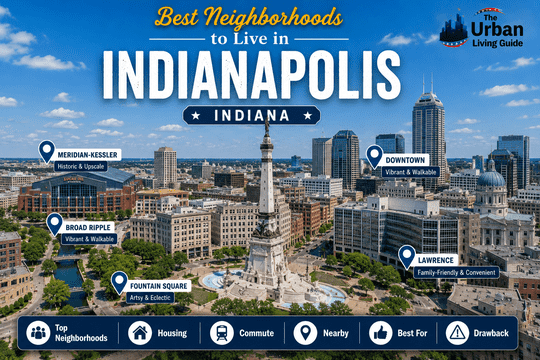
Indianapolis Neighborhoods – Where Circle City Living Goes Way Beyond the Speedway
Indianapolis has quietly become one of the Midwest’s most compelling mid-size cities to actually live in — not just visit for the Indy 500. The city of roughly 880,000 is Indiana’s capital and largest city, anchored by Eli Lilly and Company, Anthem (Elevance Health), Cummins, Indiana University Health, and a downtown built around the unusual Mile Square grid radiating from Monument Circle. The best neighborhoods in Indianapolis, Indiana range from dense walkable urban villages to quiet historic districts — each shaped by the city’s defining feature: genuinely low cost of living combined with big-city amenities most comparable Midwest cities can’t match at this price point.
Best Areas in Indianapolis, Indiana at a Glance
| Best For | Neighborhoods |
|---|---|
| 🏠 Best for Families | Broad Ripple / Meridian-Kessler — top schools, walkable village, canal access |
| 💼 Best for Young Professionals | Downtown / Mile Square — walkable, Canal Walk, corporate proximity |
| 💰 Best Affordable Area | Fountain Square — arts district, improving rents, real character |
| 🏙️ Best Luxury Area | Meridian-Kessler — historic mansions, tree-lined boulevards |
| 🎨 Best for Arts/Culture | Fountain Square / Fletcher Place — galleries, music venues, food scene |
📺 Watch this video to explore different neighborhoods and areas in Indianapolis before choosing where to live.
Top Neighborhoods in Indianapolis, Indiana
1. Downtown / Mile Square – Indy’s Walkable Corporate Core
Downtown Indianapolis sits within the historic Mile Square, radiating from Monument Circle and its iconic Soldiers’ and Sailors’ Monument. The Indianapolis Cultural Trail — an 8-mile urban bike and pedestrian path — connects downtown to surrounding neighborhoods, while the Canal Walk offers a genuinely scenic waterfront promenade lined with apartments, museums, and the NCAA Hall of Champions. Major employers like Eli Lilly, Anthem, and Cummins all maintain downtown presences, making the walk-to-work math compelling for corporate professionals.
-
- Housing: High-rise apartments, condos, and loft conversions. 1BR rents average $1,300–$1,800/month. Condos purchase from $220K–$450K.
- Commute: Walking distance to Eli Lilly, Anthem, and most major downtown employers. 10 minutes to IU Health Methodist Hospital.
- Nearby: Monument Circle, Canal Walk, Indianapolis Cultural Trail, Mass Ave Arts District (10-min walk), Lucas Oil Stadium.
Who it’s best for: Corporate professionals at Eli Lilly or Anthem, and remote workers who want Indy’s most walkable urban address. Many newcomers arriving for pharma or insurance sector roles choose downtown for the zero-commute lifestyle and Canal Walk access.
⚠️ Drawback: Downtown rents are Indy’s highest. Some residential blocks empty out significantly on weekends when the corporate workforce isn’t present.
2. Broad Ripple – Indy’s Most Beloved Walkable Village
Broad Ripple sits along the White River and the Monon Trail in north-central Indianapolis, a genuinely walkable village built around Broad Ripple Avenue’s dense strip of bars, restaurants, and live music venues. The Monon Trail — a converted rail line now stretching over 20 miles — runs directly through the neighborhood, connecting to downtown and northern suburbs by bike. It’s Indy’s closest equivalent to a true urban village, with a social energy that draws the entire metro on weekends.
-
- Housing: Bungalows, apartments, and some newer condos. 1BR rents average $1,100–$1,500/month. Purchase prices range $240K–$420K.
- Commute: About 15–20 minutes to downtown Indianapolis by car. Direct Monon Trail bike access to downtown in roughly 30 minutes.
- Nearby: Broad Ripple Avenue dining and nightlife, Monon Trail, White River access, Indianapolis Art Center (10-min walk).
Who it’s best for: Young professionals and creatives who want Indy’s most authentic walkable neighborhood identity. Among the best neighborhoods in Indianapolis, Indiana, Broad Ripple consistently wins for genuine social energy and trail access combined.
⚠️ Drawback: Weekend nightlife brings significant noise and parking competition on Broad Ripple Avenue itself — blocks a few streets back are quieter but lose some walkability.
3. Meridian-Kessler – Indianapolis’s Historic Prestige Address
Meridian-Kessler runs along Meridian Street north of downtown, a neighborhood of substantial 1920s–1940s homes — Tudor revivals, Colonials, and American Foursquares — on broad, tree-lined boulevards that represent some of Indy’s finest historic residential architecture. It feeds into highly-regarded school options and carries a settled, established character that draws professionals who’ve outgrown Broad Ripple’s social scene but want similar proximity to the Monon Trail.
-
- Housing: Large single-family historic homes. Purchase prices range $320K–$650K. Limited rentals; 2BR units average $1,400–$1,800/month.
- Commute: About 15 minutes to downtown Indianapolis via Meridian Street. 10 minutes to Broad Ripple.
- Nearby: Monon Trail access, Broad Ripple village (10-min drive), Crown Hill Cemetery and Park, Butler University (10-min drive).
Who it’s best for: Established professionals and families who want Indianapolis’s most architecturally significant neighborhood with strong schools and Monon Trail access nearby. Locals consistently recommend Meridian-Kessler when families ask where to settle long-term in central Indy.
⚠️ Drawback: Older homes require ongoing maintenance investment. Limited rental inventory means buyers dominate the market here.
4. Fountain Square – Indy’s Creative District With Real Momentum
Fountain Square sits southeast of downtown, a former industrial and entertainment district now home to Indy’s most concentrated independent arts and dining scene. The Fountain Square Theatre Building anchors a strip of galleries, music venues, and restaurants, while the Cultural Trail connects it directly to downtown. The neighborhood’s revival over the past 15 years has been genuinely organic — driven by artists and small business owners rather than large-scale developers.
-
- Housing: Converted bungalows, apartments, and newer infill. 1BR rents average $1,050–$1,400/month. Purchase prices range $200K–$380K.
- Commute: About 5–10 minutes to downtown Indianapolis by car or Cultural Trail bike. 15 minutes to IU Health main campus.
- Nearby: Fountain Square Theatre Building, Garfield Park (10-min walk — Indy’s oldest park, Sunken Garden), Cultural Trail direct access, Fletcher Place (adjacent, walkable).
Who it’s best for: Creatives, young professionals, and first-time buyers who want Indy’s most dynamic emerging neighborhood at prices still below Broad Ripple. Among the best areas in Indianapolis, Indiana for value-focused movers who want genuine character, Fountain Square consistently delivers.
⚠️ Drawback: Some blocks remain in earlier stages of revival — conditions vary noticeably street by street. Limited green space within the immediate commercial core.
5. Irvington – Indy’s Historic East Side Hidden Gem
Irvington sits on Indianapolis’s east side, a former independent town (annexed in 1902) with a genuinely distinct identity — curving streets (unusual for Indy’s grid), Victorian and Craftsman homes, and a historic district that hosts one of the Midwest’s most celebrated Halloween festivals every October. Irvington’s walkable commercial strip along Washington Street and its own small-town civic pride set it apart from Indy’s more central neighborhoods.
-
- Housing: Victorian and Craftsman homes, many historically protected. Purchase prices range $180K–$340K — strong value for the architectural quality. 1BR rents average $900–$1,200/month.
- Commute: About 15–20 minutes to downtown Indianapolis via Washington Street. 20 minutes to Eli Lilly corporate campus.
- Nearby: Irvington Historic District, Ellenberger Park, Washington Street dining and shops, Butler-Tarkington (10-min drive).
Who it’s best for: Buyers who want genuine historic character and community identity at Indy’s best price-to-architecture ratio. Irvington’s tight-knit civic culture — block parties, the Halloween Festival, neighborhood associations — gives it a sense of place rare in a city this size.
⚠️ Drawback: Further from downtown and the Monon Trail corridor than north-side neighborhoods. Some blocks require more research, as the historic district transitions unevenly into surrounding areas.
Best Neighborhoods in Indianapolis, Indiana – Quick Comparison
| Neighborhood | Vibe | Avg. 1BR Rent | Commute to Downtown | Best For |
|---|---|---|---|---|
| Downtown / Mile Square | Urban / Corporate | $1,300–$1,800 | Walking | Corporate professionals, remote workers |
| Broad Ripple | Walkable / Social | $1,100–$1,500 | 15–20 min | Young professionals, creatives |
| Meridian-Kessler | Historic / Prestige | $1,400–$1,800 (2BR) | 15 min | Established buyers, families |
| Fountain Square | Creative / Emerging | $1,050–$1,400 | 5–10 min | First-time buyers, artists |
| Irvington | Historic / Community | $900–$1,200 | 15–20 min | Character buyers, community-focused |
Which Indianapolis Neighborhood Is Right for You?
You want walkable corporate proximity → Downtown / Mile Square — Canal Walk, Monument Circle, Eli Lilly and Anthem within walking distance.
You want Indy’s best social and trail-access combo → Broad Ripple — Monon Trail, dense nightlife, genuine village energy.
You’re relocating with family and want historic character → Meridian-Kessler — tree-lined boulevards, strong schools, established prestige.
You want Indy’s most dynamic emerging neighborhood → Fountain Square — galleries, Cultural Trail access, real momentum at lower prices.
You want genuine community identity at the best price → Irvington — Victorian charm, civic pride, Indy’s best architecture-to-dollar ratio.
Frequently Asked Questions
What is the safest neighborhood in Indianapolis?
Meridian-Kessler and Irvington consistently report lower crime rates among Indy’s urban neighborhoods — both predominantly owner-occupied with stable, long-term demographics.
Best neighborhoods in Indianapolis for young professionals?
Downtown for corporate walkability. Broad Ripple for social energy and trail access.
Where should families live in Indianapolis?
Meridian-Kessler for historic character and schools. Irvington for families who want community identity at lower prices.
Is Indianapolis affordable?
Very — average home prices run 40–50% below comparable Chicago or Minneapolis neighborhoods, making Indy one of the Midwest’s best urban value propositions.
Is Indianapolis a good place to live in 2026?
Strongly yes — Eli Lilly, Anthem, Cummins, a genuinely walkable downtown, and the Monon and Cultural Trail networks make Indianapolis one of the Midwest’s most compelling mid-size cities for relocating professionals and families.
Explore More With The Urban Living Guide
Planning your Indianapolis move? Here are more detailed guides from The Urban Living Guide: