

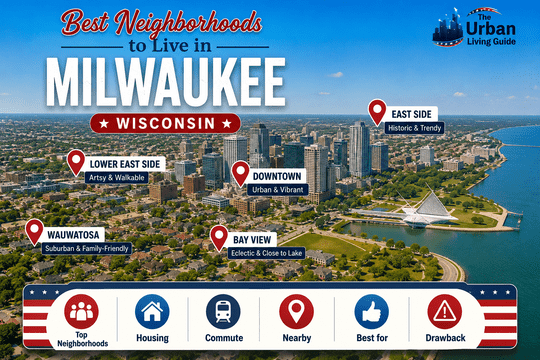
Best Neighborhoods in Milwaukee, Wisconsin – Lakefront Living, Beer Heritage, and Real City Character (2026)
Milwaukee carries a reputation built on beer — and fair enough, Miller Brewing’s roots run deep here — but residents know the city offers far more than its brewing history suggests. With a population of roughly 570,000 and a metro of 1.6 million, Milwaukee sits directly on Lake Michigan, delivering genuine lakefront access most Midwest cities can’t match. The economy runs through Northwestern Mutual, Rockwell Automation, Froedtert Health, Advocate Aurora Health, and a manufacturing base that has steadily diversified into healthcare, finance, and water technology. The best neighborhoods in Milwaukee, Wisconsin range from dense lakefront urban districts to quiet established enclaves — each carrying genuine ethnic and architectural character shaped by the city’s German, Polish, and Italian immigrant history.
Best Areas in Milwaukee, Wisconsin at a Glance
| Best For | Neighborhoods |
|---|---|
| 🏠 Best for Families | Wauwatosa — top schools, walkable village, established stability |
| 💼 Best for Young Professionals | East Side / Lower East Side — walkable, lakefront, UWM energy |
| 💰 Best Affordable Area | Bay View — strong community, lake access, improving rents |
| 🏙️ Best Luxury Area | Whitefish Bay / North Shore — lakefront homes, prestige addresses |
| 🎨 Best for Arts/Culture | Walker’s Point — galleries, food scene, industrial-chic lofts |
📺 Watch this video to explore different neighborhoods and areas in Milwaukee before choosing where to live.
Top Neighborhoods in Milwaukee, Wisconsin Based on Housing, Commute, Nearby and Drawback Factors
1. East Side / Lower East Side – Milwaukee’s Most Walkable Lakefront Neighborhood
The East Side runs along Lake Michigan from North Avenue to Capitol Drive, anchored by the University of Wisconsin-Milwaukee (UWM) campus and a dense walkable grid of independent restaurants, bars, and coffee shops along Brady Street and North Avenue. Lake Park — designed by Frederick Law Olmsted, the same landscape architect behind Central Park — offers genuine lakefront trails and the iconic Lion Bridge. Among the best neighborhoods in Milwaukee, Wisconsin, the East Side delivers the most complete walkable urban lifestyle with direct lake access built in.
-
- Housing: Apartments, duplexes, and converted historic homes. 1BR rents average $1,100–$1,500/month. Purchase prices range $220K–$420K.
- Commute: About 10–15 minutes to downtown Milwaukee by car or bus. Walking distance to UWM campus.
- Nearby: Lake Park (walking distance), Brady Street dining and nightlife, UWM campus, Milwaukee Art Museum (10-min drive), Bradford Beach (10-min walk).
Who it’s best for: UWM students, young professionals, and remote workers who want genuine lakefront access and walkability. Many newcomers arriving for Northwestern Mutual or Froedtert Health roles choose the East Side specifically for Bradford Beach summers and the Brady Street energy.
⚠️ Drawback: Parking near Brady Street is competitive on weekends. Winter on the lakefront brings genuinely intense wind chill — worth experiencing before committing long-term.
2. Bay View – Milwaukee’s Most Beloved Affordable Neighborhood
Bay View sits south of downtown along Kinnickinnic Avenue (KK), a former industrial neighborhood now home to Milwaukee’s most celebrated independent food and brewery scene — Café Centraal, Goodkind, and dozens of bars and restaurants along KK draw the entire metro. South Shore Park offers direct Lake Michigan access with views toward the downtown skyline, and the neighborhood’s mix of bungalows and Victorian duplexes keeps prices meaningfully below the East Side while delivering comparable energy.
-
- Housing: Bungalows, duplexes, and some apartment conversions. 1BR rents average $950–$1,300/month. Purchase prices range $200K–$380K.
- Commute: About 10–15 minutes to downtown Milwaukee. 20 minutes to UWM campus.
- Nearby: South Shore Park (lakefront, farmers market), KK Avenue dining strip, Sherman Perk coffee shop, Humboldt Park (10-min drive).
Who it’s best for: Budget-conscious renters and first-time buyers who want Milwaukee’s best neighborhood energy without East Side pricing. Bay View consistently ranks among the best areas in Milwaukee, Wisconsin for value-focused movers who still want a genuine social scene.
⚠️ Drawback: KK Avenue’s popularity brings weekend parking competition. Some blocks toward the southern edge remain in earlier stages of the neighborhood’s broader revival.
3. Wauwatosa – Milwaukee’s Family Neighborhood Gold Standard
Wauwatosa — locally “Tosa” — sits immediately west of Milwaukee proper, a genuinely walkable suburb with a historic Village commercial district along State Street and a newer Mayfair retail corridor. It feeds into Wauwatosa School District, consistently among Wisconsin’s strongest, and its mix of Tudor and Craftsman homes on tree-lined streets gives it a settled character that draws families away from comparable Milwaukee city neighborhoods.
-
- Housing: Single-family Tudors and Craftsman homes. Purchase prices range $320K–$580K. 2BR rents average $1,400–$1,800/month.
- Commute: About 15–20 minutes to downtown Milwaukee via I-94. 10 minutes to Froedtert Hospital and the Medical College of Wisconsin campus.
- Nearby: The Village historic district (walkable shops and dining), Hart Park (river, pool, summer concerts), Mayfair Mall, Froedtert Hospital (10-min drive).
Who it’s best for: Families relocating for Froedtert Health, Medical College of Wisconsin, or corporate roles who want Milwaukee’s best suburban school district with genuine village walkability. Locals consistently recommend Tosa first when families ask where to settle long-term.
⚠️ Drawback: Purchase prices have risen steadily — Tosa is no longer Milwaukee’s bargain suburb. Limited rental inventory in the most desirable Village-adjacent blocks.
4. Walker’s Point – Milwaukee’s Industrial-Chic Creative District
Walker’s Point sits just south of downtown along 5th Street and National Avenue, a former manufacturing district transformed into Milwaukee’s most concentrated arts and dining neighborhood. Public Market at the district’s edge, converted warehouse lofts, and a genuine Latino business community along National Avenue give Walker’s Point a layered identity — industrial-chic alongside decades-old family-owned taquerias. It’s increasingly the address young professionals choose when the East Side feels too predictable.
-
- Housing: Converted lofts, newer apartments, and some historic homes. 1BR rents average $1,150–$1,550/month. Condos from $240K–$450K.
- Commute: About 5–10 minutes to downtown Milwaukee on foot. Walking distance to Milwaukee Public Market.
- Nearby: Milwaukee Public Market, National Avenue Latino dining corridor, Harbor District (10-min walk), Third Ward (10-min walk), Lake Michigan harbor access.
Who it’s best for: Creatives, young professionals, and food-focused renters who want Milwaukee’s most dynamic emerging neighborhood. One thing people love about Walker’s Point is the genuine cultural layering — industrial history, Latino heritage, and new creative investment all visible on the same block.
⚠️ Drawback: Some Walker’s Point blocks are still in transition — development is uneven street by street. Limited green space within the immediate neighborhood.
5. Whitefish Bay – Milwaukee’s Prestige Lakefront Suburb
Whitefish Bay sits directly north of Milwaukee along Lake Michigan, part of the “North Shore” suburbs that represent the metro’s most established prestige addresses. Large Tudor, Colonial, and Cape Cod homes line streets shaded by mature trees, and the Silver Spring Drive commercial corridor delivers a walkable village center comparable to Wauwatosa’s but with direct lake proximity built in.
-
- Housing: Large single-family homes. Purchase prices range $420K–$850K+. Very limited rental inventory.
- Centrale: About 15–20 minutes to downtown Milwaukee via Lake Drive or I-43. 10 minutes to East Side amenities.
- Nearby: Lake Michigan waterfront access, Silver Spring Drive village center, Klode Park (lakefront), Whitefish Bay High School.
Who it’s best for: Established professionals and families who want Milwaukee’s most prestigious lakefront suburb with strong schools and a genuinely walkable village core. Whitefish Bay represents the area’s most consistent answer for buyers prioritizing long-term value and lake proximity.
⚠️ Drawback: Entry price is Milwaukee’s highest for single-family homes. Thin rental inventory means it’s primarily a buyer’s market.
Best Neighborhoods in Milwaukee, Wisconsin – Quick Comparison
| Neighborhood | Vibe | Avg. 1BR Rent | Commute to Downtown | Best For |
|---|---|---|---|---|
| East Side | Lakefront / Walkable | $1,100–$1,500 | 10–15 min | UWM staff, young professionals |
| Bay View | Affordable / Social | $950–$1,300 | 10–15 min | Budget renters, first-time buyers |
| Wauwatosa | Family / Village | $1,400–$1,800 (2BR) | 15–20 min | Families, Froedtert staff |
| Walker’s Point | Creative / Industrial | $1,150–$1,550 | 5–10 min walk | Creatives, young professionals |
| Whitefish Bay | Prestige / Lakefront | Limited rentals | 15–20 min | Established buyers, families |
Which Milwaukee Neighborhood Is Right for You?
You want lakefront walkability → East Side — Lake Park, Bradford Beach, Brady Street energy, UWM proximity.
Budget matters but you still want a scene → Bay View — KK Avenue dining, South Shore Park, Milwaukee’s best value-to-character ratio.
You’re relocating with family → Wauwatosa — Wisconsin’s strongest suburban schools, walkable Village, Froedtert Hospital access.
You want Milwaukee’s most dynamic emerging neighborhood → Walker’s Point — Public Market, National Avenue, industrial-chic lofts.
You want the metro’s most prestigious lakefront address → Whitefish Bay — large homes, top schools, direct Lake Michigan access.
Frequently Asked Questions
What is the safest neighborhood in Milwaukee?
Wauwatosa and Whitefish Bay consistently report the lowest crime rates among Milwaukee metro neighborhoods — both predominantly owner-occupied with stable demographics.
Best neighborhoods in Milwaukee for young professionals?
East Side for lakefront walkability. Walker’s Point for creative energy and Public Market proximity.
Where should families live in Milwaukee?
Wauwatosa for schools and village character. Whitefish Bay for families who want lakefront access alongside top-tier schools.
Is Milwaukee affordable?
Yes — average home prices run 30–40% below comparable Chicago neighborhoods, making Milwaukee one of the Midwest’s strongest lakefront value propositions.
Is Milwaukee a good place to live in 2026?
Strongly yes — Northwestern Mutual, Froedtert Health, Lake Michigan access, and genuine ethnic and architectural character make Milwaukee one of the Midwest’s most underrated major cities for relocating professionals and families alike.
Explore More
Planning your Milwaukee move? Here are more detailed guides from The Urban Living Guide: