
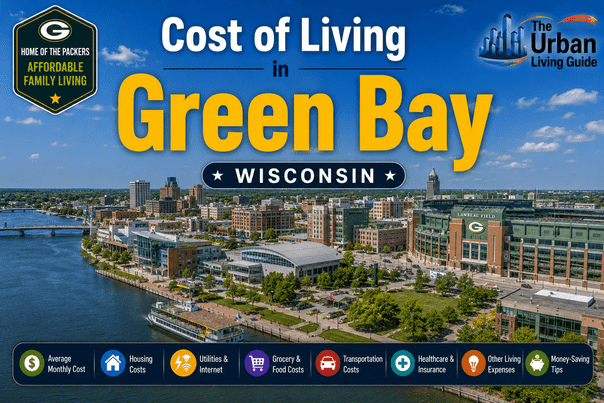
Cost of Living in Green Bay, WI: Manufacturing Hub, Healthcare Jobs & Below-Average Expenses
Green Bay delivers genuine Midwest affordability without sacrificing urban services. The economy spans healthcare, manufacturing, and education, with the University of Wisconsin-Green Bay serving as a key anchor alongside major employers like Bellin Health Systems and Schneider National. The cost of living in Green Bay is 8% lower than the National Average, with housing costing 17% less and utilities costing 16% less than the National Average. If you’re relocating for Schneider National, Bellin Health, or seeking affordable Wisconsin living with genuine opportunity, Green Bay delivers solid value. Apartments.comRedfin
This guide breaks down real 2026 costs with actual data. Many people underestimate Green Bay’s affordability compared to Milwaukee or Madison. The Green Bay Packers are woven into the city’s fabric—Lambeau Field and the surrounding Titletown District are genuine gathering points year-round, not just on game days. Apartments.com
Average Monthly Cost in Green Bay
Here’s what monthly living typically looks like:
- Single person: Around $2,200–$2,900
- Couple: Typically $3,500–$4,600
- Family of four: Approximately $5,000–$6,500
Green Bay’s 2026 cost of living is $2,538 per month for singles and $5,589 per month for families of four. Your actual spending depends on neighborhood and lifestyle choices. Salary.com
Watch this video to explore Green Bay neighborhoods, understand the Packers culture, and see what daily life looks like in Wisconsin’s most affordable major city.
Housing Costs in Green Bay
Rent here ranks among Wisconsin’s most affordable:
- Studio: Approximately $700–$900
- 1-bedroom apartment: Average monthly rent is $1,084, with median closer to $904/mo RentCafeCostOfLiving.data
- 2-bedroom units: Approximately $1,200–$1,500
- 3-bedroom homes: Approximately $1,400–$1,900 monthly
Renting in Green Bay is 18.7% lower than US average with median rent at $1,101 per month versus $1,354. Housing in Green Bay is 11% lower than US average with a median home price of $477,675 versus $534,127. Downtown, Eastside, and near-Lambeau neighborhoods command slightly higher rents. Westside and outer areas offer better value. If you’re coming from Madison or Milwaukee, housing here feels noticeably cheaper—from Chicago or coastal metros, it feels shockingly affordable. HouzeoHouzeo
The rental market serves families and professionals seeking affordable space. A study found that the Green Bay Packers generated $144 million in total annual spending in Brown County, creating economic stability and job opportunities. City-Data
Utilities & Internet
Monthly costs breakdown:
- Utilities (electricity, gas, water, trash): Around $160.74 per month, with utilities 12% lower than US average RentCafe
- Internet: $50–$75 for reliable speeds
- Seasonal variations: Winter heating impacts bills; summers mild
Utilities in Green Bay cost 16% less than the National Average, helping stretch budgets significantly. Redfin
Grocery & Food Costs
Expect to spend on groceries:
- Food expenses run 14.7% below average at $341 monthly for an individual and $1,109 for a family Salary.com
- Dining out: Runs $11–$22 per meal at casual spots
- Stores: Pick ‘n Save, Aldi, Costco, Woodman’s
- No sales tax on groceries: Wisconsin exempts groceries from sales tax
Shopping at Aldi or Woodman’s keeps costs very low. Food and grocery prices in Green Bay are 0% higher than US average with everyday items like milk at $4.7 per gallon and bread at $4 per loaf contributing to affordable weekly bills. Houzeo
Transportation Costs
Transportation depends on work location and lifestyle:
- Car owners: Gas, insurance, and parking average $160–$280 monthly
- Public transit: Green Bay Metro Transit limited coverage; $60–$70 monthly pass
- Parking: Free in most neighborhoods; downtown has limited paid options
- Commuting: Most residents drive; public transit limited
Most Green Bay residents drive. Public transit covers main routes but isn’t comprehensive. Transportation in Green Bay costs 2% more than the National Average, but that’s minimal given other savings. Redfin
Healthcare & Insurance
Health insurance and medical expenses:
- Employer health insurance: Typically $160–$390 per month for individuals
- Bellin Health, Prevea Health, local clinics serve the region
- Specialist visits and prescriptions: Budget $45–$120 monthly for regular care
- Healthcare in Green Bay costs 9% less than the National Average Redfin
Other Living Expenses
Entertainment, gym memberships, phone plans, and personal care add $140–$300 monthly:
- Green Bay offers Lambeau Field tours, Packers Hall of Fame, Heritage Hill State Park, downtown concerts
- Packers culture creates unique local entertainment value
- Many outdoor activities are free or low-cost
- Family activities cost less than larger metros
Monthly Expense Snapshot
| Expense Category | Single Person | Couple | Family of Four |
| Rent (1-BR/2-BR/3-BR) | $904–$1,200 | $1,100–$1,500 | $1,400–$1,800 |
| Utilities | $161–$220 | $180–$260 | $220–$310 |
| Groceries | $341–$450 | $550–$750 | $1,100–$1,400 |
| Transportation | $160–$280 | $220–$400 | $300–$550 |
| Healthcare (basic) | $45–$120 | $90–$240 | $135–$360 |
| Entertainment/Personal | $140–$300 | $200–$450 | $250–$550 |
| TOTAL (avg monthly) | $1,751–$2,570 | $2,340–$3,600 | $3,405–$5,370 |
Annual & Yearly Expenses
Beyond monthly costs, budget for these regular annual expenses:
Vehicle-Related:
- Car insurance: $800–$1,300 yearly in Wisconsin
- Vehicle registration/renewal: $150–$250 yearly
- Maintenance & inspections: Budget $400–$800 yearly
- Winter tire investment: $200–$400 seasonal
Insurance & Protection:
- Renters insurance: $100–$200 yearly if renting
- Life insurance: $200–$600 yearly if applicable
- Homeowners insurance: $700–$1,300 yearly if purchasing
Subscriptions & Memberships:
- Streaming services: $150–$350 yearly
- Gym membership: $300–$600 yearly (used during long winters)
- Packers season ticket (optional): $800–$5,000+ yearly (very popular locally)
Professional/Administrative:
- Annual vehicle inspection: $30–$50 yearly
- Healthcare checkups: $100–$250 if not covered
- Tax preparation: $100–$300 if using professionals
Typical Yearly Non-Housing Expenses: $2,500–$4,500 depending on vehicle and lifestyle
Is Green Bay Expensive or Affordable?
Green Bay falls into the affordable category. Living in Green Bay is more expensive than the national average, with overall cost of living 3% higher, BUT The cost of living in Green Bay is 8% lower than the National Average overall. The discrepancy? Housing is significantly cheaper, but some categories (transportation) cost slightly more. The net result: genuine affordability. Salary.comRedfin
Real talk: Green Bay is the most affordable Wisconsin city for families and professionals after Springfield and smaller towns. Green Bay may be a mid-sized city, but it’s home to several major companies, including Bellin Health, the area’s largest employer with over 3,600 employees, and Schneider National with nearly 3,500 employees locally. Dallaire Realty
👤 Who Can Afford to Live Comfortably
The local median household income of $62,546 tends to stretch further here than in most parts of the country. Schneider National employees, Bellin Health workers, UW-Green Bay staff, and manufacturing professionals handle costs comfortably. If you would need $75,000 in an average US city, you would need roughly $60,000 in Green Bay for the same standard of living. LivabilityCalcLivabilityCalc
⚠️ Who May Find Green Bay Challenging
Single earners making under $38,000 will feel some rent pressure, though Green Bay remains forgiving. Service workers, retail employees, or minimum-wage earners may need roommates. The bigger challenge: limited job diversity—most employment centers around healthcare, manufacturing, and logistics. Career growth may require relocating.
Money-Saving Tips
- Rent in outer neighborhoods or Eastside for lowest costs
- Shop at Aldi, Woodman’s, or Costco instead of Pick ‘n Save
- Use Green Bay Metro Transit for local trips when possible
- Take advantage of free Lambeau Field area attractions and Heritage Hill
- Cook at home; dining out frequently increases costs
- Get roommates to split rent in student-friendly neighborhoods
- Bundle insurance policies for discounts
- Maintain vehicle regularly to avoid expensive repairs
- Use Packers pride as free entertainment—gameday energy is real
FAQs
Is Green Bay cheaper than Milwaukee?
Yes, Green Bay costs 15–25% less than Milwaukee overall. Housing is notably cheaper, and utilities run lower. Both are affordable, but Green Bay edges ahead on value.
What salary do I need to live comfortably in Green Bay?
Median household income of $62,546 supports comfortable living. Single individuals can manage on $38,000–$48,000, making Green Bay accessible to working-class households.
Are groceries expensive in Green Bay?
No, groceries run 14.7% below national average at $341/month per person. Shopping at Aldi or Woodman’s keeps costs very low.
Do I need a car in Green Bay?
Yes, most residents drive. Metro Transit covers basic routes, but public transit is limited. Car ownership is practical for work and family life.
How does Green Bay compare to other Wisconsin cities?
Green Bay is more affordable than Milwaukee and Madison but costs more than Racine, Kenosha, or smaller towns. It’s the sweet spot for affordable urban living in Wisconsin.
Explore more with The Urban Living Guide
Before moving to Green Bay, make sure you check: