

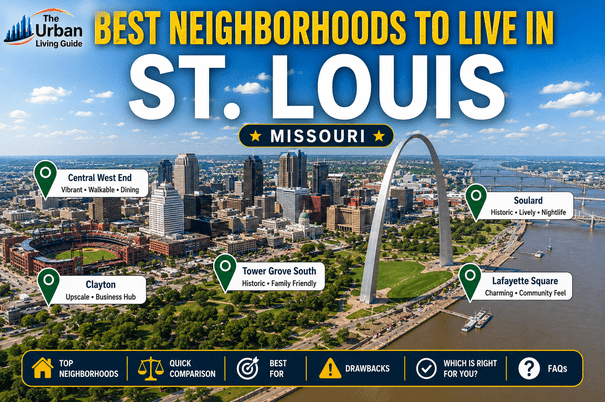
Best Neighborhoods in St. Louis, Missouri – Historic Districts, River City Character, and the Right Block for Your Life (2026)
St. Louis is a city of neighborhoods — fiercely distinct, architecturally extraordinary, and priced in a way that makes newcomers from coastal cities do a double take. The city proper has roughly 300,000 residents with a metro of 2.8 million, and its job market runs deeper than most outsiders realize: Washington University in St. Louis, BJC HealthCare, SSM Health, Boeing Defense, Edward Jones, and Anheuser-Busch all anchor a diverse employment base that keeps the city economically stable. The best neighborhoods in St. Louis, Missouri are built on some of the finest Victorian and Romanesque residential architecture in America — Cherokee Street, Lafayette Square, The Hill — each with a personality that rewards residents who invest in understanding it.
St. Louis neighborhoods divide broadly between South City (older, denser, more walkable), West End and Central West End (urban professional), and West County suburbs (family-oriented, newer construction). Here’s the real breakdown.
Best Areas in St. Louis, Missouri at a Glance
| 🏠 Best for Families | Webster Groves — top schools, tree-lined streets, suburban stability |
| 💼 Best for Young Professionals | Central West End — walkable, hospital corridor, urban energy |
| 💰 Best Affordable Area | Benton Park / Cherokee Street — historic character, lowest rents, improving |
| 🏙️ Best Luxury Area | Ladue / Clayton — executive homes, prestige address, top schools |
| 🎨 Best for Arts/Culture | The Grove / Forest Park Southeast — LGBTQ+ hub, nightlife, creative scene |
📺 Watch this video to explore different neighborhoods and areas in St. Louis before choosing where to live.
Top Neighborhoods in St. Louis, Missouri
1. Central West End – St. Louis’s Most Complete Urban Neighborhood
The Central West End (CWE) runs along Euclid Avenue and Maryland Avenue west of Forest Park — the 1,300-acre park that hosted the 1904 World’s Fair and remains one of America’s finest urban green spaces. The CWE is walkable, dense with independent restaurants and coffee shops, and sits adjacent to the Washington University Medical Center and BJC HealthCare campus — making it the natural landing spot for medical and academic professionals. Among the best neighborhoods in St. Louis, Missouri, CWE offers the most complete urban package.
- Housing: Historic apartment buildings, condo conversions, and some single-family homes. 1BR rents average $1,100–$1,550/month. Purchase prices range $250K–$550K.
- Commute: About 10–15 minutes to downtown St. Louis via I-64. Walking distance to Washington University Medical Center and BJC HealthCare.
- Nearby: Forest Park (walking distance — free zoo, art museum, science center), Euclid Avenue dining strip, Washington University Danforth Campus (10-min drive), Saint Louis Art Museum.
Who it’s best for: Medical residents, BJC and SSM Health staff, and young professionals who want St. Louis’s most walkable urban neighborhood with Forest Park as their backyard. Many newcomers arriving for Wash U or BJC roles choose CWE specifically because Forest Park access makes the neighborhood feel larger than it is.
⚠️ Drawback: Parking on Euclid Avenue is competitive on weekends. Some blocks immediately east of CWE transition quickly — staying west of Kingshighway makes a noticeable difference.
2. Lafayette Square – Historic Grandeur at St. Louis’s Best Price-to-Character Ratio
Lafayette Square sits just southwest of downtown, centered on Lafayette Park — St. Louis’s oldest public park — surrounded by some of the most remarkably preserved Victorian Italianate and Second Empire row houses in the Midwest. The neighborhood went through decades of decline before a resident-driven revival from the 1990s onward restored it to one of St. Louis’s most coveted addresses. One thing people love about Lafayette Square is the architecture — $300K buys a fully restored Victorian row house that would cost $1.5M+ in comparable East Coast neighborhoods.
- Housing: Restored Victorian row houses and some newer infill. Purchase prices range $250K–$550K. 1BR rents average $1,000–$1,400/month.
- Commute: About 5–10 minutes to downtown St. Louis by car or bike. 15–20 minutes to BJC HealthCare via I-64.
- Nearby: Lafayette Park (walking distance), Park Avenue dining strip, Anheuser-Busch Brewery (10-min drive), Soulard Farmers Market (10-min walk), Busch Stadium (15-min drive).
Who it’s best for: Buyers who want architectural character and downtown proximity at prices that remain among the best in any major American city. Lafayette Square consistently ranks among the best areas in St. Louis, Missouri for value-conscious buyers who refuse to compromise on character.
⚠️ Drawback: The neighborhood’s eastern and northern edges transition unevenly — block-level research before buying is essential. Limited retail within the immediate neighborhood means most daily errands require a short drive.
3. The Hill – St. Louis’s Italian-American Neighborhood That Never Lost Its Identity
The Hill occupies southwest St. Louis along Macklind Avenue and Edwards Street, a tight-knit Italian-American enclave that has maintained its cultural identity across generations — red, white, and green fire hydrants, bocce courts in front yards, and a concentration of Italian restaurants (Charlie Gitto’s, Rigazzi’s, Zia’s) that draws the entire metro. It’s famously the birthplace of both Yogi Berra and Joe Garagiola. Among St. Louis neighborhoods, The Hill has the strongest sense of place — residents know each other, take pride in their blocks, and protect the neighborhood’s character fiercely.
- Housing: Modest brick bungalows and two-family flats, predominantly owner-occupied. Purchase prices range $200K–$380K — among the best value in a character-rich St. Louis neighborhood. 1BR rents average $900–$1,250/month.
- Commute: About 15–20 minutes to downtown St. Louis. 10–15 minutes to Washington University and BJC HealthCare.
- Nearby: Tower Grove Park (10-min walk — one of St. Louis’s finest parks), Macklind Avenue Italian dining strip, St. Ambrose Catholic Church (neighborhood anchor), Forest Park (10-min drive).
Who it’s best for: Buyers who want a neighborhood with genuine, lasting identity at St. Louis’s most affordable owner-occupied prices. The Hill is the answer for anyone who wants to feel like they belong to a place rather than just renting space in it.
⚠️ Drawback: The Hill’s tight-knit character can feel insular to newcomers — it rewards patience. Limited apartment inventory means it skews heavily toward buyers over renters.
4. Webster Groves – St. Louis’s Family Neighborhood Standard
Webster Groves sits about 10 miles southwest of downtown St. Louis, an inner-ring suburb with a genuine town center along Lockwood Avenue — independent restaurants, a Kaldi’s Coffee, and a farmers market that draws residents from across south St. Louis County. It feeds into Webster Groves School District, consistently rated among Missouri’s strongest public school systems, and the neighborhood’s Victorian and Craftsman housing stock gives it a character most inner suburbs have long since lost.
- Housing: Single-family Victorians, Craftsmans, and some newer construction. Purchase prices range $320K–$600K. 2BR rents average $1,300–$1,700/month.
- Commute: About 20–25 minutes to downtown St. Louis via I-44. MetroLink Light Rail at Webster Groves Station to downtown in 30–35 minutes.
- Nearby: Lockwood Avenue village center, Webster University campus, Blackburn Park, Tilles Park (10-min drive), Westport Plaza retail (15-min drive).
Who it’s best for: Families relocating to St. Louis for BJC, Boeing, or Edward Jones roles who want Missouri’s best suburban school district in a neighborhood that doesn’t feel like a suburb. Locals consistently recommend Webster Groves when families ask where to commit long-term in the St. Louis area.
⚠️ Drawback: Purchase prices have risen faster than most St. Louis neighborhoods — entry-level inventory under $350K moves quickly. The MetroLink commute is viable but requires a car to reach the station from most blocks.
5. Benton Park & Cherokee Street – South City’s Affordable Creative Corridor
Benton Park sits in South St. Louis along Cherokee Street — a mile-long antique, art, and taco corridor that has become one of the most talked-about streets in the Midwest for its genuine multicultural character and independent business density. The surrounding Benton Park neighborhood delivers classic St. Louis brick bungalows and two-family flats at the city’s most accessible prices, drawing artists, young professionals, and budget-conscious buyers who want South City character without South City’s rising price points in more established neighborhoods.
- Housing: Brick bungalows, two-family flats, and some apartment conversions. Purchase prices range $130K–$280K — St. Louis’s most accessible for buyers. 1BR rents average $800–$1,100/month.
- Commute: About 10–15 minutes to downtown St. Louis by car. 15–20 minutes to BJC HealthCare.
- Nearby: Cherokee Street antique and dining corridor, Benton Park green space, Anheuser-Busch Brewery (10-min walk), Soulard Farmers Market (10-min walk), Lemp Mansion.
Who it’s best for: First-time buyers, artists, and budget renters who want authentic St. Louis South City character at the lowest entry price of any connected neighborhood. Cherokee Street alone — with its Day of the Dead festival and independent taco shops — justifies the address for culture-seeking newcomers.
⚠️ Drawback: Some Benton Park blocks require careful research — conditions vary significantly street by street. The neighborhood is improving but unevenly, and buyers should do thorough due diligence before committing to specific blocks.
Best Neighborhoods in St. Louis, Missouri – Quick Comparison
| Neighborhood | Vibe | Avg. 1BR Rent | Commute to Downtown | Best For |
|---|---|---|---|---|
| Central West End | Urban / Medical | $1,100–$1,550 | 10–15 min | Medical staff, young professionals |
| Lafayette Square | Historic / Prestige | $1,000–$1,400 | 5–10 min | Character buyers, downtown workers |
| The Hill | Cultural / Community | $900–$1,250 | 15–20 min | Community-focused buyers |
| Webster Groves | Family / Schools | $1,300–$1,700 (2BR) | 20–25 min | Families, long-term buyers |
| Benton Park / Cherokee | Affordable / Creative | $800–$1,100 | 10–15 min | First-time buyers, artists |
Which St. Louis Neighborhood Is Right for You?
You want walkable urban life near Forest Park → Central West End — Euclid Avenue dining, BJC proximity, and one of America’s best parks as your backyard.
You want architectural character at an unbeatable price → Lafayette Square — Victorian grandeur, Lafayette Park, downtown in 10 minutes.
You want to belong to a real community → The Hill — St. Louis’s most identity-rich neighborhood with the best Italian food in the Midwest.
You’re relocating with family and schools matter most → Webster Groves — Missouri’s strongest suburban school district in a neighborhood with genuine town character.
Budget is the primary constraint → Benton Park / Cherokee Street — St. Louis’s most affordable connected neighborhood with a cultural scene that punches far above its price point.
Frequently Asked Questions
What is the safest neighborhood in St. Louis? Webster Groves, The Hill, and Central West End (west of Kingshighway) consistently report the lowest crime rates. St. Louis has well-documented city-wide crime challenges — neighborhood and block-level research before committing to any address is strongly recommended.
Best neighborhoods in St. Louis for young professionals? Central West End for walkability and medical corridor proximity. Lafayette Square for character and downtown access at lower rent.
Where should families live in St. Louis? Webster Groves for schools and town character. The Hill for families who want a tight-knit community feel at lower prices.
Is St. Louis affordable? Extremely — average home prices run 50–60% below comparable Chicago or Minneapolis neighborhoods. Benton Park and The Hill in particular offer some of the best ownership value of any major American city.
Is St. Louis a good place to live in 2026? St. Louis has real challenges — crime statistics require honest acknowledgment — but the residential neighborhoods covered here have remained strong. Wash U, BJC, Boeing, and Edward Jones provide genuine economic anchors, and the city’s architectural character and cost of living remain compelling for movers willing to research at the neighborhood level.
Explore More
Planning your St. Louis move? Here are more detailed guides from The Urban Living Guide: