

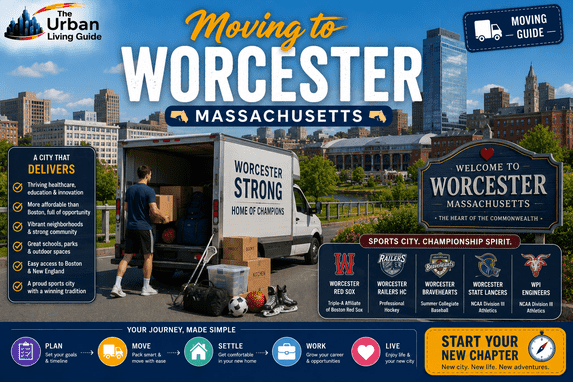
Moving to Worcester, Massachusetts – The Heart of the Commonwealth Has a Serious Moment
Worcester doesn’t just ask you to give it a chance — it earns one. For years, Massachusetts outsiders treated this city as the scrappy alternative to Boston, the fallback option for people who couldn’t make the numbers work in the city. That narrative is shifting fast. In 2026, Worcester ranked third nationally for home sales growth, according to Massachusetts real estate analysts, and the Canal District redevelopment has turned what was once an industrial corridor into one of Central Massachusetts’s most walkable mixed-use neighborhoods. The ‘Heart of the Commonwealth‘ nickname isn’t just geography — it describes a city that’s increasingly central to how people are rethinking relocation in this state.
The numbers tell a practical story. The median home price in Worcester sits around $430,000 — well below Boston’s $825,000. A one-bedroom apartment in a convenient location near downtown runs $1,800–$2,200, compared to Boston’s $3,417 average. That gap is closing, but it hasn’t closed yet. If you’re relocating from Greater Boston or another expensive metro, Worcester can genuinely reset your financial breathing room without cutting you off from regional career opportunities.
Explore the real city atmosphere through this video by a well-known local Worcester vlogger — the Canal District footage alone will give you a feel for how much this city has changed.
Where Are You Moving From?
How your Worcester move feels depends enormously on what you’re leaving behind. Someone downsizing from a Boston apartment has a completely different logistics puzzle than a family relocating cross-country from Texas. Understanding your specific move category helps you plan realistically — both for costs and for the adjustment period afterward.
- Same-State Move (from Greater Boston or nearby MA cities): This is the most common Worcester relocation pattern in 2026, as Boston-area households push west for housing relief. A local moving crew can typically handle this in a single day. Budget $500–$1,100. The commuter rail back to Boston runs about 75 minutes and costs around $400/month for a pass — factor that into your actual savings calculation before celebrating the rent difference.
- Interstate Move (from CT, RI, NY, NH): Mid-complexity. Most movers complete this in one day. Budget $1,000–$2,800. Worcester’s downtown parking and residential street access is generally easier than Boston — trucks can usually maneuver without the permit complexity you’d face in the city.
- Long-Distance Move (from Midwest, South, West Coast): Requires thorough planning. Full-service movers run $3,500–$8,500. Arriving without a lease signed is risky in Worcester’s current market — inventory moves quickly, particularly in the West Side and Shrewsbury Street corridors. Use a short-term Airbnb or Extended Stay as a landing pad while you tour in person.
One thing that surprises newcomers arriving from smaller towns: Worcester is a genuine mid-sized city with real urban density, not just a big suburb. Coming from a larger metro like Chicago or Philadelphia, you’ll find the scale comfortable and the cost difference refreshing.
⚠️ Who May Find Worcester Challenging?
Worcester offers value compared to Greater Boston, but it may not suit everyone. While the city provides commuter rail access and urban conveniences, some residents find that transportation costs and lifestyle expectations can affect their overall experience.
-
- Daily commuting to Boston can become expensive despite access to the MBTA Commuter Rail
- Monthly commuter rail costs can significantly reduce housing savings for frequent commuters
- Public transit is more limited than in Boston, making car ownership useful for many residents
- Winters can be challenging for those relocating from warmer climates
- Certain neighborhoods require more research than others before choosing a home
- Residents seeking Boston-level nightlife, dining, or cultural density may find Worcester smaller in scale
Worcester works best for people seeking affordability and opportunity, but less so for those expecting a seamless Boston-style urban experience.
⚠️ Who May Find Worcester Challenging?
Worcester offers value compared to Greater Boston, but it may not suit everyone. While the city provides commuter rail access and urban conveniences, some residents find that transportation costs and lifestyle expectations can affect their overall experience.
-
- Daily commuting to Boston can become expensive despite access to the MBTA Commuter Rail
- Monthly commuter rail costs can significantly reduce housing savings for frequent commuters
- Public transit is more limited than in Boston, making car ownership useful for many residents
- Winters can be challenging for those relocating from warmer climates
- Certain neighborhoods require more research than others before choosing a home
- Residents seeking Boston-level nightlife, dining, or cultural density may find Worcester smaller in scale
Worcester works best for people seeking affordability and opportunity, but less so for those expecting a seamless Boston-style urban experience.
Moving Process and Transportation Planning
Worcester moves are logistically more forgiving than Boston moves in most respects. Street access is better, parking is less contested, and you won’t typically need to navigate the intense September 1st lease turnover chaos that defines Boston’s moving season. That said, the city’s housing market is now genuinely competitive — moving in without a plan is increasingly risky as demand continues to climb.
-
- Local Worcester moves: $400–$900 for a one to two bedroom with a professional crew
- Boston-to-Worcester move: typically $600–$1,400 depending on volume and specific addresses
- Interstate moves: $1,000–$3,000 from most Northeast states
- Cross-country: $3,500–$8,500 with full-service movers
- Truck rental: 16-foot trucks run $100–$200/day locally; availability is much better here than in Boston
- WRTA (Worcester Regional Transit Authority) covers local bus routes; Commuter Rail at Union Station links to Boston’s South Station in approximately 75 minutes
- Car ownership is more practical here than in Boston — parking is accessible and most suburban errands require driving
One thing many people relocating from Boston underestimate: while Worcester is more car-friendly, you still want to understand which neighborhoods are walkable before choosing your address. The area around Shrewsbury Street and the Canal District is genuinely pedestrian-friendly. South Worcester and much of the city’s outer ring is not.
Housing Strategy in Worcester’s 2026 Market
Worcester’s housing market in 2026 is not the sleepy alternative it was five years ago. The city’s national ranking for home sales growth means inventory moves fast, and the ‘affordable alternative’ reputation has attracted enough buyers to push median prices to around $430,000. That’s still well below Boston, but it’s not the bargain basement it once was. Renters in the current market are finding one-bedrooms in desirable areas running $1,800–$2,200, while outlying neighborhoods can still deliver $1,400–$1,700 for a decent unit.
-
- Rent before buying unless you know the city well: Worcester’s neighborhood variation is real. West Side and Shrewsbury Street are strong; other areas need more research before committing.
- Temporary housing options: Airbnb offers furnished options in the downtown area, and Extended Stay America has a Worcester-area location useful for multi-week arrivals.
- Broker fees: Worcester’s rental market doesn’t carry Boston’s mandatory broker fee culture as heavily — many rentals list directly. Still, verify before assuming.
- Scam awareness: Online rental scams target people relocating from out of state. Never wire transfer rent to a landlord you haven’t met and a property you haven’t visited.
- Canal District lofts: Converted mill buildings offer unique spaces with high ceilings and character, and they rent quickly. Put these on your tour list early.
📦 Storage & Setup Essentials
Worcester’s housing stock tends to offer more space than many communities in Greater Boston, making the moving process a bit easier for newcomers. From traditional triple-deckers to single-family homes and newer developments, residents often find they have more room for storage and everyday living.
-
- Public Storage and Extra Space Storage offer storage facilities throughout the Worcester area
- Housing options generally provide more space than comparable Boston apartments
- Eversource supplies electricity and gas service for much of the city
- Average utility costs are around $190–$200 per month for a typical apartment
- Comcast Xfinity is the primary internet provider in many neighborhoods
- Most utility and internet services can be activated within a few days
- Scheduling electric and internet setup before move-in day is recommended
With a little advance planning, getting settled in Worcester is typically straightforward and less stressful than in many higher-density Massachusetts cities.
The First Few Weeks — What Worcester Actually Feels Like
People who arrive in Worcester expecting a smaller, quieter Boston are usually pleasantly surprised. The city has a genuine identity of its own — the restaurant scene along Shrewsbury Street is real, the arts and music culture has depth, and the pace of daily life is noticeably more relaxed than the Boston metro grind. Many newcomers don’t realize how embedded university life is in this city’s daily rhythm: WPI, Clark, and Worcester State all operate year-round and contribute to a consistently young, active energy in the city’s core neighborhoods.
- Commute reality check: If you’re commuting to Boston by rail, test the timing before assuming it works for your schedule. The 75-minute trip plus station time means a real daily commitment.
- Neighborhood feel: Shrewsbury Street is Worcester’s food and social hub. Canal District is the growth edge. West Side is where families who want green space tend to land.
- Weather: Same Massachusetts winters as Boston — 40+ inches of snow is realistic. Worcester sits slightly inland, which can mean colder temperatures without the coastal moderation Boston gets.
- Community depth: Worcester has a genuinely diverse population with strong Southeast Asian, Latino, and Irish-American communities. That cultural mix shapes the food, the events, and the social texture of the city in ways that take time to discover and appreciate.
Things to Know Before You Arrive
Worcester operates on Massachusetts rules, which means your out-of-state driver’s license must be converted within 30 days of establishing residency ($115 fee). Massachusetts sales tax is 6.25% statewide — groceries and clothing under $175 are exempt. Parking in Worcester is dramatically less stressful than Boston, but downtown street parking has time limits and permit zones in residential areas. UMass Memorial Medical Center is the city’s anchor healthcare institution and consistently rated among the region’s best. One practical heads-up: September in Worcester is noticeably busier than any other month because all three major universities begin their academic year simultaneously — factor this into your move timing if possible.
🎭 Local Insights & Lifestyle Feel
Worcester has evolved into one of Massachusetts’ most interesting mid-sized cities, blending historic character with ongoing redevelopment. Its growing food scene, cultural institutions, and entertainment options give residents access to urban amenities without the pace or cost of Boston.
-
- The Canal District has become a hub for restaurants, breweries, galleries, and new residential development
- Polar Park, home of the Worcester Red Sox, continues to drive growth and activity in the surrounding area
- Shrewsbury Street is known for its restaurants, nightlife, and local dining scene
- The Worcester Art Museum is widely regarded as one of New England’s most underrated cultural attractions
- The Hanover Theatre for the Performing Arts regularly hosts Broadway shows, concerts, and live performances
- Easy access to outdoor recreation, including Wachusett Mountain and the Wachusett Reservoir area
For many residents, Worcester offers a balance of culture, entertainment, outdoor access, and affordability that is increasingly difficult to find elsewhere in Massachusetts.
Quick Moving Checklist
Worcester’s housing market moves faster than most people expect. Getting organized early — especially on neighborhood research and lease timing — makes a real difference in both the quality and cost of what you land.
30 Days Before:
-
- Choose your target neighborhood (West Side, Shrewsbury Street area, Canal District, or outlying areas)
- Book moving company or truck rental
- Start apartment search and schedule in-person tours — don’t sign remotely
- Arrange short-term housing if arriving without a signed lease
- Contact Eversource to set up electricity and gas service
- Research commuter rail schedule if Boston trips are part of your life
1 Week Before:
-
- Confirm all moving bookings in writing
- Pack and label by room — Worcester apartments vary in size significantly
- Set up internet installation (Comcast Xfinity dominant in most areas)
- Prepare funds for move-in costs: typically first + security deposit + any broker fee
- Locate nearest WRTA bus stop and Union Station for rail access
Moving Day:
-
- Photograph old residence before departing
- Confirm utility activation at new address
- Get landlord/super contact information immediately
- Do a full walkthrough and document any existing damage in writing
- Explore your new neighborhood on foot within the first 48 hours
✅ The Bottom Line on Worcester in 2026
Worcester continues to strengthen its position as one of Massachusetts’ most attractive alternatives to Greater Boston. With a growing economy, expanding cultural scene, and housing costs that remain more attainable than many eastern Massachusetts communities, the city is drawing increasing attention from professionals, families, students, and remote workers.
-
- Strong employment base anchored by UMass Memorial Health Care, education, and professional services
- More affordable housing than many Boston-area cities, though prices continue to rise
- Growing entertainment, dining, and redevelopment districts such as the Canal District
- Convenient access to both Boston and Central Massachusetts destinations
- Offers a balance of urban amenities and a more manageable cost of living
- Best suited for residents seeking opportunity, community, and long-term value
For many newcomers, Worcester delivers a compelling combination of affordability, career opportunities, cultural growth, and quality of life without the intensity and expense of Greater Boston.
FAQs — Moving to Worcester, Massachusetts
How much cheaper is Worcester than Boston?
Worcester apartments run roughly 40–50% less than comparable Boston units. A one-bedroom in Worcester averages $1,800–$2,200 vs. Boston’s $3,417. Daily Boston commuters should subtract the $400/month rail pass from that savings.
Is Worcester a good city for families?
Yes, particularly in the West Side neighborhood. UMass Memorial Medical Center provides excellent healthcare access, and the city has a mix of public, charter, and private school options. WPI and Clark University add an educated community presence.
How do I get from Worcester to Boston?
Commuter Rail from Union Station to Boston South Station runs approximately 75 minutes. Monthly pass is around $400. Driving via I-90 (Mass Pike) takes 45–75 minutes depending on traffic.
What neighborhoods should I look at first?
West Side for families and green space, Shrewsbury Street area for food and walkability, Canal District for urban character and newer development. Research crime data at the neighborhood level before committing.
Is the job market strong in Worcester?
Yes, particularly in healthcare (UMass Memorial), higher education (WPI, Clark, WSU), and growing sectors in advanced manufacturing and logistics. The city also benefits from proximity to Boston’s broader biotech and tech job market.
Helpful Local Resources Before Moving
These resources are actually used by people settling into Worcester — not just generic government links. Each one saves time on a different part of the relocation process:
- City of Worcester Official Site — New resident services, parking permits, trash and recycling schedules, and city department contacts.
- WRTA (Worcester Regional Transit Authority) — Local bus route maps, schedules, and pass options for getting around without a car.
- UMass Memorial Health Care — Largest local healthcare network for establishing new patient care and locating specialists.
- Union Station / MBTA Commuter Rail — Schedules, monthly pass costs, and real-time status for the Worcester–Boston commuter line.
Explore More With The Urban Living Guide
If you’re still weighing the decision or want to understand Worcester at a deeper level before committing, these companion guides cover every major aspect of daily life:
- Living in Worcester, Massachusetts
- Cost of Living in Worcester, Massachusetts
- Pros and Cons of Living in Worcester, Massachusetts
- Best Neighborhoods in Worcester, Massachusetts