
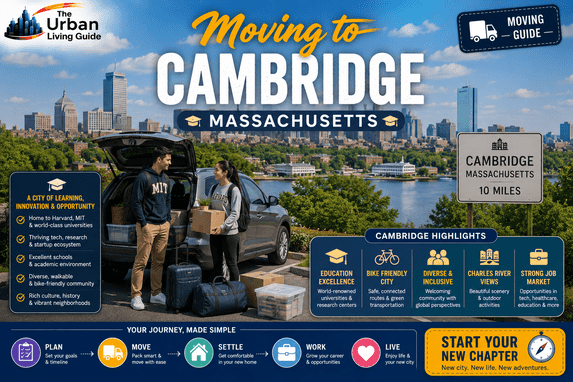
Moving to Cambridge, Massachusetts – Seven Square Miles That Changed the World
Cambridge compresses an extraordinary amount into a very small space. Seven square miles. Two of the world’s most influential universities. The stretch of Kendall Square that researchers call ‘the most innovative square mile on the planet.’ One of the most walkable urban environments in New England. And a cost of living that runs 60–70% above the national average — a figure that absorbs salaries that would feel generous in most other American cities. Moving to Cambridge is not a casual decision. It’s a city you move to with purpose: for a specific position, a postdoc, a research lab, a tech role, a graduate program. People who arrive here for those reasons tend to stay far longer than planned. People who arrive hoping that Cambridge’s reputation will substitute for a clear reason often leave within eighteen months.
Cambridge’s median rent across all unit types sits at $3,311/month in 2026. A single person needs roughly $4,800–$6,200/month for comfortable living. Families of four should budget $9,800–$12,800/month. A salary of $120,000–$150,000 is the realistic minimum for a single person to live comfortably here without financial stress. These are not estimates designed to intimidate — they are the actual planning parameters that experienced Cambridge relocators use.
Get a closer feel for Cambridge’s daily lifestyle by watching this local vlogger’s guide – particularly useful for understanding different things.
Moving to Cambridge, Massachusetts – Where Are You Moving From?
Cambridge is compact, but the logistics of getting there vary enormously based on your origin point. The city’s density and parking constraints — particularly around Harvard Square and Central Square — mean that moving truck access requires real planning regardless of where you’re coming from. Cambridge also has its own version of the September 1st lease turnover phenomenon, driven by Harvard and MIT academic calendars: late August and early September are the most chaotic and expensive windows to move in.
-
- Boston or Inner Suburbs Move: Most Cambridge arrivals come from within Greater Boston. A local moving crew handles this efficiently in a half-day to full day. Budget $500–$1,200. The critical variable is building access: older Cambridge triple-deckers and converted Victorians have narrow stairwells, and elevator buildings may have specific move-in windows managed by building management. Contact your building management office before your move date.
- Interstate Move (from Northeast corridor): Mid-complexity. Budget $1,200–$3,000. Cambridge’s dense residential streets mean a smaller truck (16-foot rather than 26-foot) is sometimes more practical for final-mile access. Plan your unloading logistics before arrival day.
- Cross-Country Move: Full-service movers run $4,500–$10,000+. Given Cambridge’s cost of living, many cross-country relocators arrive with a furnished short-term rental booked for four to six weeks — the apartment search is intense and signing remotely carries real risk.
If you’re relocating from Philadelphia, Baltimore, or another Northeast city and received what looks like a generous salary increase for your Cambridge position, run the housing numbers carefully before celebrating. Many people discover that their raise is partially or entirely consumed by the Cambridge housing premium on arrival.
🎯 Who Cambridge Is Built For
Cambridge attracts a highly educated and career-focused population, making it one of the most unique cities in the United States. The city’s economy revolves around higher education, biotechnology, life sciences, research, and innovation, creating opportunities that are difficult to find elsewhere. For people whose careers align with these industries, Cambridge offers exceptional access to employers, professional networks, and academic resources.
-
- Ideal for academics, researchers, scientists, and life sciences professionals
- Home to globally recognized institutions such as Harvard University, MIT, the Broad Institute, and the Whitehead Institute
- Strong opportunities within the Kendall Square biotech and innovation ecosystem
- Excellent fit for technology professionals, startup founders, and engineers
- Popular among graduate students, postdoctoral researchers, and university staff
- Attractive for consultants, finance professionals, and legal professionals seeking access to both Cambridge and Boston
- Walkable neighborhoods and strong public transit reduce the need for a car
- Families often value communities such as Cambridgeport and North Cambridge, along with highly regarded schools including Cambridge Rindge and Latin School
- Best suited for people who value education, innovation, research, and an intellectually driven environment
For many residents, Cambridge’s greatest strength is its concentration of world-class universities, research institutions, and innovative companies, all within a highly walkable and community-oriented city.
⚠️ Who Will Struggle in Cambridge?
Cambridge offers exceptional opportunities, but it is not a city that works well for every lifestyle or budget. High housing costs, limited parking, and a dense urban environment can make daily life challenging for some residents. Before moving, it’s important to understand that many of these factors are not temporary issues—they are part of what defines Cambridge as a city.
-
- People on tighter budgets may find Cambridge’s housing market difficult to sustain long term
- Median rents often exceed $3,300 per month, with many desirable apartments ranging from $2,500–$4,500+
- Home prices in areas such as West Cambridge can exceed $1.3 million
- Residents who rely heavily on a personal vehicle may struggle with limited parking and high garage costs
- The city is designed around walking, cycling, and public transit rather than driving
- Families seeking large homes, private yards, and suburban-style living may find options limited
- Housing costs are often 20–30% higher than comparable neighborhoods in nearby Boston
- Best suited for people who prioritize location, career opportunities, and walkability over space and affordability
For many residents, the benefits of Cambridge outweigh the challenges, but the city tends to work best for those who arrive with realistic expectations and a budget that comfortably supports its high cost of living.
Moving Logistics and Transportation in Cambridge
Cambridge moving logistics require more advance planning than most cities because of building density, narrow historic streets, limited parking, and the shared September move-in chaos driven by university calendars. Cambridge requires a city parking permit for moving trucks — apply to the Cambridge Traffic, Parking and Transportation department at least seven days before your move date. This is not optional and applies even for small moves. Building management in larger residential complexes often requires advance scheduling of the elevator and loading dock.
- Local Cambridge or Boston-area moves: $500–$1,500 depending on volume and building access complexity
- Interstate moves: $1,200–$3,500 from most Northeast states
- Cross-country moves: $4,500–$10,000+ with full-service movers
- Moving permit: Required from Cambridge TPT — apply minimum 7 days ahead
- Truck size: Consider a 16-foot truck rather than full size for tight streets near Harvard Square and Central Square
- MBTA Red Line: The backbone of Cambridge transit — Harvard, Central, Kendall/MIT, and Porter Square all on one line with frequent service to downtown Boston
- Cycling infrastructure: Cambridge has some of the most extensive protected bike lanes in Massachusetts — many residents commute by bike year-round
- Car ownership: Genuinely optional for most Cambridge residents and financially preferable — skip the car if your lifestyle allows it
The MBTA’s ongoing capital improvement program — $9.6 billion over five years — includes digital signaling for the Red Line that should eliminate the majority of delay points by end of 2026. Red Line reliability is already improving and will continue to do so.
Housing Strategy in Cambridge’s Brutal Market
Cambridge’s housing market is one of the tightest in the country. Vacancy rates hover near 2.7%, and good units in desirable neighborhoods move within days of listing. September 1st is simultaneously the biggest lease turnover date and the most chaotic time to search — thousands of students, postdocs, and university employees all move simultaneously. If you can time your arrival for October through March, you will find a meaningfully better experience with less competition and sometimes lower advertised rents. If you’re locked into September, start searching at least two months out.
- Harvard Square: Academic energy, premium location, premium price. Studios start near $2,800.
- Kendall Square / East Cambridge: Biotech and tech hub — higher-end newer developments plus converted industrial spaces. Rents reflect the demand.
- Central Square: More diverse and slightly more affordable than Harvard Square. Strong arts scene. Good Red Line access.
- North Cambridge: Family-oriented, quieter, lower density, more manageable rents. Green Line Extension access.
- Cambridgeport: Family-friendly, excellent schools, median home prices around $957,000.
- Porter Square: Between Cambridge and Somerville — slightly more affordable, good Red Line and Commuter Rail access.
- Temporary housing: Furnished Airbnbs in Cambridge and adjacent Somerville work well for arrival buffers. Plan for two to four weeks minimum if you’re searching in person on arrival.
📦 Setup & Storage in Cambridge
Moving to Cambridge often requires a bit more planning than newcomers expect. Many apartments are located in historic triple-deckers, older multifamily homes, and Victorian-era conversions, which frequently offer less storage space and smaller room sizes than newer developments. As a result, some residents find that temporary storage becomes a practical part of their move.
-
- Apartments in older Cambridge buildings often have limited closet and storage space
- Storage facilities in Cambridge and nearby Somerville can fill quickly during peak moving periods, especially around September
- Booking storage 4–6 weeks in advance is recommended during busy seasons
- Eversource provides electricity service throughout much of Cambridge
- Residents are typically enrolled in the Cambridge Community Electricity Program, which may offer competitive rates
- Water service is managed by the Cambridge Water Department
- Internet providers commonly include Comcast Xfinity and RCN/Astound
- Internet plans generally range from $60–$100 per month
- Older buildings may have higher winter heating costs, with some residents budgeting $150–$250 per month during colder months
Planning for storage, utilities, and seasonal expenses before moving can help make your transition into Cambridge smoother and more predictable.
The First Weeks in Cambridge — What Newcomers Don’t See Coming
The intellectual density of Cambridge is its most distinctive feature — and the thing most newcomers underestimate as a daily experience. This is a city where your neighbors are likely to include Nobel laureates, MacArthur fellows, leading startup founders, and graduate students who will be running major institutions in ten years. That energy is real and genuinely motivating for people who thrive in it. It’s also a city where the social baseline can feel intimidating until you find your people, which typically happens through your institution, your neighborhood, or the many active community organizations that Cambridge hosts.
- Cost shock timeline: Most people who move to Cambridge from lower-cost cities describe a 60-to-90-day period of financial adjustment before the new spending patterns normalize.
- Car-free lifestyle transition: If you’re arriving from a car-dependent city, the Red Line and Cambridge’s cycling network will feel revelatory once you trust them. Give it four to six weeks.
- Academic calendar effects: Cambridge is noticeably quieter in late December and during academic breaks, then intensely busy from September through early December and February through May. Plan your social expectations around this cycle.
- Community integration: Cambridge Residents Alliance, neighborhood associations, and community events organized through Cambridge Community Television (CCTV) are underrated entry points into local life.
📌 Things to Know Before You Arrive
Cambridge has a few local requirements and practical considerations that are worth understanding before moving. Taking care of these details early can help make your transition smoother and prevent unnecessary surprises during your first few weeks.
-
- Out-of-state drivers must obtain a Massachusetts driver’s license within 30 days of establishing residency
- The current license conversion fee is approximately $115
- New residents are typically enrolled in the Cambridge Community Electricity Program
- Moving trucks often require city-issued parking permits for certain locations
- Cambridge has an extensive network of bike lanes and cycling infrastructure
- Eligible households with heat pump systems may qualify for seasonal utility discount programs through Eversource
🚲 Local Insights & Lifestyle Feel
Cambridge offers a lifestyle centered around education, innovation, and community engagement. The city is known for its intellectual atmosphere, vibrant public spaces, and highly walkable neighborhoods. Residents enjoy easy access to cultural events, independent bookstores, local restaurants, and outdoor recreation throughout the year.
-
- Harvard Square and Central Square are popular hubs for dining, events, and local culture
- The Charles River Esplanade is a favorite destination for walking, cycling, and outdoor activities
- The Cambridge Public Library system is widely used and highly regarded
- Public lectures, university events, and community programs are common throughout the city
- The MBTA Red Line provides quick access to downtown Boston and surrounding areas
- Many residents enjoy a car-free lifestyle thanks to strong transit and walkability
For many people, Cambridge combines the energy of a major academic center with the convenience of a compact, community-focused city.
Quick Moving Checklist
Cambridge moves require more advance preparation than moves to almost any other Massachusetts city. The permit requirement alone can derail a move if you miss the 7-day application window.
30 Days Before:
-
- Choose your Cambridge neighborhood based on work location and Red Line access
- Begin apartment search — Cambridge inventory moves in days, not weeks
- Book moving company — avoid late August and September if possible
- Apply for Cambridge moving truck parking permit (min. 7 days before move — cambridgema.gov/tpt)
- Contact building management about elevator scheduling and loading dock access
- Arrange short-term furnished housing for arrival buffer if searching in person
- Confirm your Cambridge Community Electricity enrollment with Eversource
1 Week Before:
-
- Confirm all moving bookings — cross-check with building management
- Consider whether a 16-foot truck is more practical than a 26-foot for your specific streets
- Pack with space constraints in mind — Cambridge apartments run small
- Schedule internet installation (Comcast Xfinity or RCN/Astound)
- Prepare $9,000–$14,000+ in move-in funds: first, last, security, possible broker fee
Moving Day:
-
- Confirm parking permit is displayed on truck
- Photograph old residence before departure
- Verify all utilities are active at new Cambridge address
- Test your Red Line commute route within the first 48 hours
- Locate Fresh Pond Reservation or Charles River Esplanade — your outdoor reset valves
✅ The Honest Verdict on Cambridge
Cambridge is one of the most unique and opportunity-rich cities in the United States, but it works best for people who have a clear reason for being there. The city offers exceptional access to Harvard University, MIT, Kendall Square, and some of the world’s leading research and biotechnology organizations. Its reputation for innovation, walkability, education, and career growth is well deserved.
-
- Outstanding opportunities in research, biotechnology, technology, and higher education
- Home to globally recognized institutions such as Harvard University and MIT
- Highly walkable with strong public transit and limited reliance on cars
- Rich cultural, academic, and intellectual environment
- Among the most expensive housing markets in the country
- Best suited for residents with a stable income, academic opportunity, or career-focused relocation plan
For many residents, Cambridge’s combination of career access, academic excellence, innovation, and quality of life makes the investment worthwhile. However, those considering a move should be prepared for the city’s high costs and competitive housing market before making the leap.
FAQs — Moving to Cambridge, Massachusetts
What salary do I need to live comfortably in Cambridge?
Singles need roughly $120,000–$150,000/year. Couples should target $180,000–$230,000 combined. Families with children need $230,000–$300,000+ depending on childcare and school choices.
What is the average rent in Cambridge in 2026?
The median rent across all unit types is $3,311/month. One-bedrooms in central neighborhoods start around $2,800–$3,500. Studios average $2,500–$3,200. Even outer Cambridge neighborhoods run significantly above the national average.
Do I need a car in Cambridge?
No — and for most residents, not owning a car is the financially and logistically superior choice. The MBTA Red Line, bus network, and Cambridge’s extensive bike lane infrastructure cover daily needs for most residents.
What is the moving permit requirement?
Cambridge requires a parking permit for moving trucks from the city’s Traffic, Parking and Transportation department. Apply at least 7 days before your move date at cambridgema.gov/tpt. Non-compliance results in a ticket.
What are the best neighborhoods in Cambridge for families?
Cambridgeport and North Cambridge are the most consistently recommended. Cambridge Rindge and Latin School is one of the strongest public high schools in Massachusetts. Cambridgeport has a median home price around $957,000.
Helpful Local Resources Before Moving
These resources are genuinely useful for the practical work of arriving in Cambridge — permits, utilities, transit, and healthcare — not just informational links:
- Cambridge Traffic, Parking and Transportation — Apply for your moving permit here. Required. Do not skip this step.
- MBTA — Plan your Red Line commute, purchase monthly passes, and track capital improvement timelines for the 2026 system upgrades.
- Eversource — Activate electricity service and confirm Community Electricity program enrollment upon arrival.
- Cambridge Public Health Department — New resident health resources, local healthcare provider network, and community wellness programs.
Explore More With The Urban Living Guide
These companion guides give you the full picture of Cambridge life before you commit:
- Living in Cambridge, Massachusetts
- Cost of Living in Cambridge, Massachusetts
- Pros and Cons of Living in Cambridge, Massachusetts
- Best Neighborhoods in Cambridge, Massachusetts