

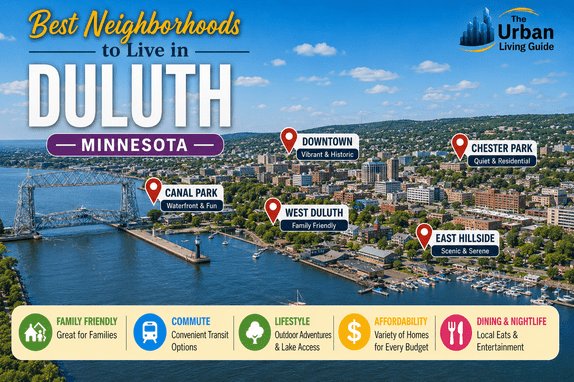
Best Neighborhoods in Duluth, Minnesota – Hillside Views, Harbor Life, and Real Neighborhood Choices (2026)
Duluth is unlike any other city in Minnesota. Built on a dramatic ridge above Lake Superior — the largest freshwater lake in the world by surface area — the city’s geography defines everything: which neighborhood you live in determines your view, your commute gradient, your proximity to the water, and your access to Duluth’s 100+ miles of hiking and biking trails. The city of roughly 90,000 residents anchors the western tip of Lake Superior and functions as a regional hub for northeastern Minnesota, with a growing economy built around healthcare (Essentia Health, St. Luke’s Hospital), the University of Minnesota Duluth (UMD), and a tourism and outdoor recreation industry that draws millions annually.
For newcomers, Duluth’s neighborhood layout can feel confusing at first — the city runs along a narrow strip of hillside for nearly 26 miles, which means “north” and “south” matter far less than “up the hill” or “down by the lake.” This guide maps the best areas in Duluth, Minnesota against real criteria: rent, commute, school access, and the kind of lifestyle each neighborhood actually delivers.
Best Areas in Duluth, Minnesota at a Glance
| 🏠 Best for Families | Woodland — top-rated schools, quiet streets, close to UMD |
| 💼 Best for Young Professionals | Lincoln Park — arts district, affordable lofts, walkable energy |
| 💰 Best Affordable Area | West Duluth — genuine value, strong community, improving amenities |
| 🏙️ Best Luxury Area | East Hillside / Hunter’s Park — Lake Superior views, historic character |
| 🌊 Best for Outdoor Access | Canal Park / Downtown — lakefront living, trail access, harbor views |
📺 Watch this video to explore different neighborhoods and areas in Duluth before choosing where to live.
Top Neighborhoods in Duluth, Minnesota
1. Canal Park & Downtown – Duluth’s Lakefront Living Hub
Canal Park sits at the base of Duluth’s hillside where the Aerial Lift Bridge connects the city to Minnesota Point (locally called “the Park Point”) across the Duluth Ship Canal. It’s the city’s most recognizable address — the waterfront, the Lakewalk trail, DECC convention center, and a dense cluster of restaurants and hotels along Canal Park Drive. Living here means genuine lakefront access and the energy of Duluth’s most visited district, year-round.
- Housing: Primarily apartments, condos, and newer mixed-use buildings. 1BR rents average $1,200–$1,700/month. Condos start around $250K–$450K.
- Commute: Walking distance to most downtown employers and Essentia Health St. Mary’s campus. About 15 minutes by car to UMD via Skyline Parkway.
- Nearby: Aerial Lift Bridge, Lakewalk (4.2-mile waterfront trail), Great Lakes Aquarium, Fitger’s Brewhouse on Superior Street, Vista Fleet harbor cruises.
Who it’s best for: Young professionals and remote workers who want Duluth’s most iconic address. Many newcomers arriving in Duluth for Essentia Health or St. Luke’s positions choose Canal Park for the first year simply to experience the lake on their doorstep.
⚠️ Drawback: Tourism traffic in summer and fall makes Canal Park genuinely crowded — parking is difficult from June through October, and restaurant waits can be long on weekends. Winter wind off Lake Superior is intense and relentless.
2. Lincoln Park – Duluth’s Creative District on the Rise
Lincoln Park occupies the lower hillside west of downtown, centered on West Superior Street and Lincoln Park itself — a large green space along Miller Creek. It was a working-class neighborhood for most of the 20th century and is now firmly in transition, driven by a craft beverage and food scene that includes Bent Paddle Brewing on Michigan Street, Ursa Minor Brewing, and a growing cluster of independent shops and studios along West Superior Street.
- Housing: Older single-family homes, duplexes, and a growing number of renovated apartments. 1BR rents average $850–$1,200/month — among the best value in a connected Duluth neighborhood.
- Commute: About 5–8 minutes to downtown by car or bike via Superior Street. DTA bus Route 9 connects Lincoln Park to downtown frequently.
- Nearby: Lincoln Park green space and Miller Creek trail, Bent Paddle Brewing, Duluth Grill on Grand Avenue, Wrenshall Trail connection, Denfeld High School.
Who it’s best for: Budget-conscious renters and young creative professionals who want neighborhood energy at Duluth’s lowest connected price points. Renters often consider Lincoln Park when they want to be part of something growing rather than something already arrived.
⚠️ Drawback: Revitalization is real but uneven — some blocks along West Superior Street remain underdeveloped, and the neighborhood’s transition means a variable experience depending on which street you’re on.
3. Woodland – Duluth’s Family Neighborhood Standard
Woodland sits in the upper hillside of eastern Duluth, stretching from Woodland Avenue up toward the University of Minnesota Duluth campus boundary. It’s quieter than nearly any other Duluth neighborhood — residential streets wind through mature tree cover, and the proximity to UMD brings a stable, educated demographic without the student-housing density you’d find directly adjacent to campus. Many residents prefer this area because the school quality is Duluth’s most consistent: Woodland Middle School and the ISD 709 elementary feeds here are routinely cited as top performers in the district.
- Housing: Primarily single-family homes from the 1950s–1980s, well-maintained, with some newer construction on upper lots. Purchase prices range $220K–$420K. 2BR rentals average $1,100–$1,500/month.
- Commute: About 5–8 minutes to UMD on foot or by bike. Approximately 15–20 minutes to downtown Duluth via Arrowhead Road or Skyline Parkway.
- Nearby: University of Minnesota Duluth campus, Hartley Nature Center (300-acre nature reserve — walking distance), Whole Foods co-op on Kenwood Avenue, Chester Bowl ski area (10-min drive).
Who it’s best for: Families relocating to Duluth for UMD faculty positions or Essentia Health roles who want the best school access and a neighborhood that stays genuinely quiet. If you’re relocating with school-age children, Woodland is the area locals recommend first.
⚠️ Drawback: Limited walkability for daily errands — most grocery and retail runs require a car. The upper hillside location also means steeper roads that require caution in Duluth’s long winters.
4. East Hillside & Hunter’s Park – Historic Character With Lake Superior Views
The East Hillside runs above downtown Duluth from Third Street up to Skyline Parkway, transitioning into the more established Hunter’s Park neighborhood toward the east. These are Duluth’s most architecturally significant residential areas — Victorian homes, brick Craftsman bungalows, and early 20th-century foursquares built by the city’s original merchant and professional class. Many of the homes on upper East Second Street and East Third Street carry unobstructed views of Lake Superior and the harbor.
- Housing: Historic single-family homes, many with significant architectural detail. Purchase prices range $180K–$600K+ depending on condition, location, and lake views. 1BR apartment conversions average $950–$1,350/month.
- Commute: About 8–12 minutes to downtown via Superior Street or Interstate 35. Walking distance to several Essentia Health clinic locations on East Second Street.
- Nearby: Glensheen Mansion (historic estate, 10-min drive), Leif Erikson Park and rose garden on the lakefront, Chester Creek Trail, UMD (15-min drive), Fitger’s Complex on Superior Street (restaurants, hotel, shops).
Who it’s best for: Buyers looking for architectural character and lake views at prices significantly below comparable lakefront markets nationally. One thing people love about East Hillside is waking up to a Lake Superior panorama that would cost multiples more in any coastal city.
⚠️ Drawback: Older homes come with real maintenance demands — many hillside properties have aging infrastructure, steep driveways, and heating costs that spike in Duluth’s severe winters. Buyers should budget for ongoing upkeep.
5. West Duluth – Affordable, Unpretentious, and Community-Strong
West Duluth stretches along the lower hillside and flatlands west of Lincoln Park, centered on Grand Avenue between 63rd Avenue West and Grand Avenue’s western commercial anchors. It’s the most affordable section of Duluth and proud of it — a working-class neighborhood with a strong sense of identity, a growing local food and brewery scene anchored by Carmody Irish Pub and Fitgers on the Lake offshoots, and some of the most genuinely affordable housing in any Minnesota city of comparable connectivity.
- Housing: Older single-family homes, duplexes, and modest apartments. Purchase prices range $130K–$280K — genuine starter home territory. 1BR rents average $750–$1,050/month.
- Commute: About 15–20 minutes to downtown by car via Grand Avenue or I-35. DTA Route 11 connects West Duluth to downtown on a regular schedule.
- Nearby: Spirit Mountain ski and recreation area (5-min drive), Jay Cooke State Park (15-min drive), Western Waterfront Trail, Duluth Entertainment Convention Center (DECC) (20-min drive), Tri-Star Grocery and Cub Foods on Grand Avenue.
Who it’s best for: First-time buyers, budget renters, and anyone who wants to own in Minnesota without stretching a budget. This area works best if you’re comfortable in a neighborhood that values community over polish — West Duluth residents tend to be long-term and deeply rooted.
⚠️ Drawback: Commercial amenities along Grand Avenue are improving but still limited compared to eastern Duluth. Some stretches of West Duluth have higher property crime rates — block-level research before leasing or buying is worthwhile.
Best Neighborhoods in Duluth, Minnesota – Quick Comparison
| Neighborhood | Vibe | Avg. 1BR Rent | Commute to Downtown | Best For |
|---|---|---|---|---|
| Canal Park / Downtown | Lakefront / Tourist | $1,200–$1,700 | Walking | Young professionals, remote workers |
| Lincoln Park | Arts / Up-and-Coming | $850–$1,200 | 5–8 min | Budget renters, creatives |
| Woodland | Family / Academic | $1,100–$1,500 | 15–20 min | Families, UMD-affiliated |
| East Hillside / Hunter’s Park | Historic / Views | $950–$1,350 | 8–12 min | Buyers, view-seekers |
| West Duluth | Affordable / Working-class | $750–$1,050 | 15–20 min | First-time buyers, value renters |
Final Thoughts
The best neighborhoods in Duluth, Minnesota are shaped by a geography unlike anywhere else in the state. Your decision between hillside and lakeside, east and west, isn’t just about preference — it affects your commute, your heating bill, your school options, and how much of Lake Superior you see from your window. Canal Park delivers the iconic Duluth experience; Woodland wins on school quality; Lincoln Park offers the best value in a neighborhood actively building its identity; East Hillside rewards buyers who want character and views; and West Duluth is the honest choice for anyone prioritizing ownership over ambiance.
Duluth’s overall cost of living remains one of the most favorable in the Upper Midwest — home prices and rents are significantly lower than Minneapolis, Saint Paul, or comparable lakefront markets nationally, while quality of life indicators like trail access, air quality, and community stability remain high. For anyone drawn to outdoor living, water access, and a city that wears its character openly, Duluth consistently delivers.
Frequently Asked Questions
What is the safest neighborhood in Duluth?
Woodland and Hunter’s Park consistently report Duluth’s lowest crime rates. Both are predominantly owner-occupied residential areas with stable, long-term demographics.
What are the best neighborhoods in Duluth for young professionals?
Canal Park and Lincoln Park are the top picks. Canal Park offers the lakefront lifestyle and walkability; Lincoln Park delivers the creative energy and lower rents that make more financial sense early in a career.
Where should families live in Duluth, Minnesota?
Woodland is the standard recommendation — top school feeds, proximity to UMD, and a genuinely quiet residential environment. Hunter’s Park in the East Hillside area is a strong second for families who want more architectural character.
Is Duluth affordable compared to other Minnesota cities?
Yes — significantly. Average home prices in Duluth run 40–50% lower than comparable Minneapolis neighborhoods. Rental rates are the lowest of any major Minnesota city, making it particularly attractive for first-time buyers and budget-conscious renters.
Is Duluth a good place to live in 2026?
Duluth offers a quality of life that’s hard to replicate at its price point — Lake Superior access, 100+ miles of trails, a growing arts and food scene, and anchor employers in Essentia Health, St. Luke’s Hospital, and UMD. The main consideration is the climate: Duluth winters are long, cold, and genuinely demanding. Residents who embrace outdoor winter activity tend to thrive; those who don’t often leave within a few years.
Explore More
Planning your Duluth move? Here are more detailed guides from The Urban Living Guide: