
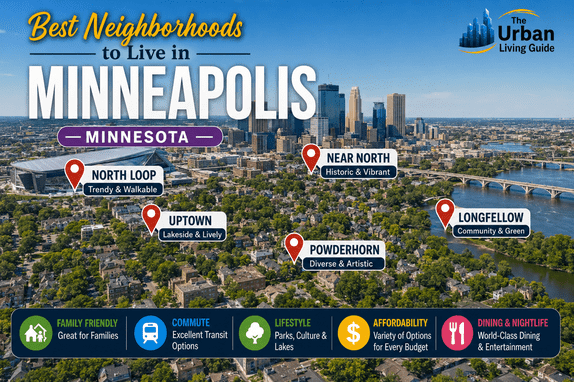
Best Neighborhoods in Minneapolis, Minnesota – Finding Your Fit in the City of Lakes (2026)
Choosing the right neighborhood in Minneapolis is more than just a zip-code decision — it shapes your commute, your social life, your grocery run, and your weekend routine. The city is famously diverse in character: you can live ten minutes from downtown in a trendy arts district, or settle into a quiet lakeside block that feels nothing like a major metro. Minneapolis has grown steadily as a tech, healthcare, and finance hub, drawing newcomers from across the Midwest and beyond. Whether you’re relocating for a job at Mayo Clinic’s Twin Cities campus, a role in the medical device corridor, or remote work flexibility, understanding where to live in Minneapolis makes all the difference.
If you’re a young professional looking for walkable nightlife, a family prioritizing top-rated schools, or a renter trying to stay under $1,400/month, this guide breaks down the best areas in Minneapolis by real-life criteria — not just reputation.
Best Areas in Minneapolis, Minnesota at a Glance
| 🏠 Best for Families | Linden Hills — top-rated Southwest schools, quiet cul-de-sacs near Lake Harriet |
| 💼 Young Professionals | North Loop — warehouse-chic living, walkable to Target Field and the CBD |
| 💰 Best Affordable | Powderhorn Park — strong community identity, improving infrastructure, budget-friendly rents |
| 🏙️ Best Luxury | Kenwood — grand historic homes, Lake of the Isles frontage, established prestige |
| 🎨 Best for Arts/Culture | Northeast Minneapolis — gallery district, craft breweries, murals on every block |
📺 Watch this video to explore different neighborhoods and areas in Minneapolis before choosing where to live.
Top Neighborhoods in Minneapolis, Minnesota
1. Uptown – Minneapolis’s Most Walkable Urban Village
Uptown sits southwest of downtown along the shores of Lake Calhoun (Bde Maka Ska) and Lake Harriet, anchored by Hennepin Avenue and Lyndale Avenue South. It’s the neighborhood most newcomers picture when they imagine city life in Minneapolis — coffee shops, indie boutiques, nightlife, and bike paths running past the lakes. Many residents prefer this area because everything from groceries at Whole Foods on Hennepin to a weekend kayak rental is genuinely within walking distance.
Housing: Mostly apartment buildings and converted duplexes. Average 1BR rent ranges from $1,350–$1,700/month. Condos and townhomes are available for buyers in the $300K–$500K range.
Commute: Approximately 10–15 minutes to downtown Minneapolis via W Lake Street or Hennepin Avenue. Metro Transit Route 6 connects directly to Nicollet Mall.
Nearby: Bde Maka Ska (swimming, paddleboarding), Calhoun Square, Minneapolis Institute of Art (15-min drive), Trader Joe’s on Hennepin.
Who It’s Best For
Uptown works best if you’re a young professional or creative who wants to live car-light. Remote workers who need a change of scenery will love the density of independent coffee shops — indeed, many newcomers arriving in Minneapolis choose Uptown specifically for the walkability score and the energy of the Hennepin/Lake Street corridor.
One Thing to Know
Drawback: Parking is genuinely challenging — street spots on nights and weekends near the Uptown Triangle are nearly impossible. If you own a car, factor in the cost of a reserved parking spot ($100–$150/month).
2. Northeast Minneapolis – The Arts District That Became a Neighborhood
Northeast Minneapolis, locally called “NE,” runs along the east bank of the Mississippi River, stretching from the University of Minnesota’s East Bank campus up through St. Anthony Main. Once a working-class Polish and Eastern European enclave, NE has transformed into one of the Twin Cities’ most celebrated creative districts — think art galleries, breweries like Bauhaus Brew Labs on 18th Avenue NE, and weekend markets.
Housing: A mix of older craftsman bungalows, newer apartment complexes near Central Avenue NE, and converted warehouse lofts. 1BR averages $1,200–$1,550/month — slightly more affordable than Uptown.
Commute: 8–12 minutes to downtown by car via I-35W or Central Avenue. Green Line light rail at the East Bank station connects to Target Field Station in about 12 minutes.
Nearby: Grain Belt Commons, Sheridan Memorial Park, University of Minnesota (walking distance from the south end), Surly Brewing Co. destination taproom.
Who It’s Best For
Renters often consider Northeast when they want creative energy without Uptown’s price premium. If budget is your main concern but you still want a vibrant neighborhood identity, NE is frequently the answer locals recommend. Many newcomers drawn to Minneapolis’s arts reputation settle here within their first year.
One Thing to Know
Drawback: Traffic on Central Avenue NE can be slow during morning rush toward downtown. The Green Line is a good workaround, but the station is a 10–15 minute walk from many NE blocks.
3. North Loop – Downtown-Adjacent, Brewery-Fueled, Professionally Polished
The North Loop occupies Minneapolis’s old warehouse district just northwest of Target Field, bound by the Mississippi River to the north and Washington Avenue to the south. In under a decade it went from vacant loading docks to one of the most sought-after neighborhoods for professionals in the entire Twin Cities metro. One thing people love about the North Loop is the sheer concentration of quality — acclaimed restaurants like Spoon and Stable on Washington Avenue, boutique fitness studios, and rooftop bars all within a 10-block radius.
Housing: Predominantly luxury apartment towers and converted industrial lofts. Expect 1BR rents starting at $1,600–$2,100/month. Condo ownership starts around $350K.
Commute: 5–8 minutes to the CBD on foot or by bike. Metro Transit’s Route 14 and the Target Field light rail hub are both steps away.
Nearby: Target Field (Minnesota Twins), Armory event venue, Whole Foods Market on Washington, Bassett Creek Valley Trail for cyclists.
Who It’s Best For
For young professionals who want to live within walking distance of work in the financial district or corporate headquarters along Nicollet Mall, the North Loop is the natural pick. If commute matters more than rent, this neighborhood makes that tradeoff simple — your commute becomes a five-minute walk.
One Thing to Know
Drawback: Higher rent is the main barrier. It’s consistently the most expensive neighborhood in Minneapolis for rentals, and game-day crowds on Twins and Vikings matchdays can make parking and restaurant access stressful if you live near Target Field.
4. Linden Hills – Southwest Minneapolis’s Family Anchor
Linden Hills sits in the far southwest corner of Minneapolis, flanked by Lake Harriet to the north and Minnehaha Creek to the south. It has the feel of a small town inside a big city — a charming commercial strip on Upton Avenue South, independent bookstores, and tree-lined residential streets where kids bike to school. If you’re moving with family, Linden Hills deserves a serious look: it feeds into Kenwood Elementary and Southwest High School, both consistently rated among Minneapolis’s highest-performing public schools.
Housing: Primarily single-family homes from the 1920s–1950s, with some newer infill construction. Home prices typically range from $450K–$800K. Rentals are limited but exist, averaging $1,500–$1,900/month for a 2BR house.
Commute: About 20 minutes to downtown via I-35W or France Avenue South. Limited direct bus routes mean most residents commute by car.
Nearby: Lake Harriet (band shell concerts, sailing), Linden Hills Park, Whole Foods on France Avenue, Trader Joe’s at 50th & France.
Who It’s Best For
Families relocating to Minneapolis who want quality schools, lake access, and a neighborhood where kids can safely play outside consistently choose Linden Hills. Locals often recommend it to anyone prioritizing long-term stability over urban buzz.
One Thing to Know
Drawback: Limited public transit means car dependency for most errands. Southwest Minneapolis can also feel far from downtown social life, which matters if you’re used to more urban energy.
5. Powderhorn Park – Affordable, Multicultural, and Evolving
Powderhorn Park runs along East 38th Street in South Minneapolis, centered on the large Powderhorn Lake park that gives the neighborhood its name. It’s one of Minneapolis’s most culturally diverse areas, with a strong Mexican and Central American community along the Lake Street corridor, independent restaurants, and a neighborhood identity built around community activism and mutual aid. Many residents prefer this area because of its genuine character — this isn’t a polished gentrified district, it’s a real working neighborhood with some of the city’s most affordable rents.
Housing: Mostly older single-family homes and duplexes, many renter-occupied. Average 1BR rent sits around $950–$1,250/month — among the lowest of any well-connected Minneapolis neighborhood.
Commute: 15–20 minutes to downtown via Lake Street or Chicago Avenue. Metro Transit Route 21 (Lake Street) runs frequently and reaches downtown in 25–30 minutes.
Nearby: Powderhorn Park (summer arts festival, lake skating in winter), Mercado Central on Lake Street, Minneapolis College of Art and Design (10-min drive).
Who It’s Best For
For remote workers who need affordable rent without sacrificing city connectivity, Powderhorn Park is a strong option that locals and long-time Minneapolis residents often cite. Many newcomers on tighter budgets landing in Minneapolis discover this neighborhood after finding Uptown rents out of range.
One Thing to Know
Drawback: Parts of Powderhorn Park have seen elevated property crime rates in recent years. Doing block-level research before signing a lease is wise — the neighborhood varies noticeably street by street.
6. Kenwood – Historic Luxury Between the Lakes
Kenwood is Minneapolis’s most prestigious residential neighborhood, tucked between Lake of the Isles and Cedar Lake in the city’s southwest quadrant. The streets are broad, the elm trees are enormous, and the homes are some of the finest historic architecture in Minnesota — Tudor revivals, Craftsman mansions, and Georgian colonials dating to the 1900s–1930s. One thing people love about Kenwood is its quiet grandeur: you’re a five-minute drive to Uptown’s restaurants but come home to a completely calm, residential environment.
Housing: Almost exclusively large single-family homes. Entry-level pricing starts around $700K; lakefront properties on Lake of the Isles regularly list above $2M.
Commute: 15–20 minutes to downtown Minneapolis via I-394 or Hennepin Avenue. Limited transit options — most Kenwood residents commute by car.
Nearby: Lake of the Isles (year-round trails, winter skating), Cedar Lake Trail (bikeway to downtown), The Walker Art Center (10-min drive), Theodore Wirth Parkway for running.
Who It’s Best For
Kenwood is the right fit for established professionals or executives who want the best of Minneapolis residential life — great schools via private enrollment or the Southwest cluster, lake access, and a neighborhood that retains its value consistently.
One Thing to Know
Drawback: The price of entry is significant. Kenwood is not for first-time buyers or renters — inventory is thin, competition is real, and the area lacks walkable daily amenities compared to Uptown.
Best Neighborhoods in Minneapolis, Minnesota – Quick Comparison
| Neighborhood | Vibe | Avg. 1BR Rent | Commute to DT | Best For |
| Uptown | Trendy / Walkable | $1,350–$1,700 | 10–15 min | Young professionals, creatives |
| Northeast (NE) | Arts / Industrial | $1,200–$1,550 | 8–12 min | Budget-conscious, art lovers |
| North Loop | Luxury / Urban | $1,600–$2,100 | 5–8 min | Professionals, no-commute seekers |
| Linden Hills | Family / Quiet | $1,500–$1,900 | 20 min | Families, school-focused buyers |
| Powderhorn Park | Diverse / Affordable | $950–$1,250 | 20–25 min | Budget renters, remote workers |
| Kenwood | Luxury / Historic | $2,000+ (rare) | 15–20 min | Executives, established buyers |
Final Thoughts – Finding Your Best Neighborhood in Minneapolis, Minnesota
Minneapolis rewards residents who take the time to match their lifestyle to the right neighborhood. The best neighborhoods in Minneapolis, Minnesota aren’t one-size-fits-all: a North Loop apartment is ideal for someone whose office is on Nicollet Mall, while Linden Hills makes perfect sense for a family putting schools first. Northeast Minneapolis continues to attract creative professionals who want community without the premium rent, and Powderhorn Park remains the entry point for budget-conscious renters discovering the city.
If you’re relocating to Minneapolis, spend a weekend walking Uptown’s lake paths, browsing NE’s galleries, and driving through Linden Hills before making a decision. The best areas to live in Minneapolis reveal themselves through lived experience — and every neighborhood on this list has a version of city life worth considering.
Frequently Asked Questions – Best Neighborhoods in Minneapolis
What is the safest neighborhood in Minneapolis?
Linden Hills and Kenwood consistently rank among the safest neighborhoods in Minneapolis based on property crime and violent crime rates. Both are residential, owner-occupied, and well-maintained. Uptown and the North Loop are also relatively safe by city standards, though urban neighborhoods carry higher baseline risk than suburban-style areas.
What are the best neighborhoods in Minneapolis for young professionals?
The North Loop and Uptown are the top choices for young professionals. The North Loop offers walkability to the CBD and a vibrant after-work scene, while Uptown provides more affordable rents with lake access and a livelier arts-and-nightlife culture. Northeast Minneapolis is a strong runner-up for those who prioritize affordability.
Where should families live in Minneapolis?
Linden Hills is widely considered the top family neighborhood in Minneapolis, thanks to its school ratings, park access, and safe, quiet streets near Lake Harriet. Kenwood is another excellent option for families who can afford the higher price of entry. Both neighborhoods feed into Southwest High School, one of Minneapolis’s highest-performing public high schools.
What is the most affordable neighborhood in Minneapolis?
Powderhorn Park offers some of the lowest rents in a well-connected Minneapolis neighborhood — typically $950–$1,250/month for a one-bedroom. It’s a genuinely multicultural community with strong neighborhood identity, though prospective renters should research specific blocks before committing.
Is Minneapolis a good city to move to in 2026?
Yes — Minneapolis consistently ranks highly for quality of life, healthcare access (anchored by the Mayo Clinic and HCMC systems), and a diverse job market across healthcare, finance, tech, and manufacturing. The city’s extensive chain-of-lakes park system and vibrant neighborhoods make it attractive for a wide range of movers. The main consideration is the Minnesota winter, which runs longer and colder than most U.S. cities, but locals adapt quickly with the right gear and mindset.
Explore more
For more on living in the Twin Cities, explore full guides by The Urban Living Guide here –
Living in Minneapolis, Minnesota,
Cost of Living in Minneapolis, Minnesota
Pros and Cons of Living in Minneapolis, Minnesota