

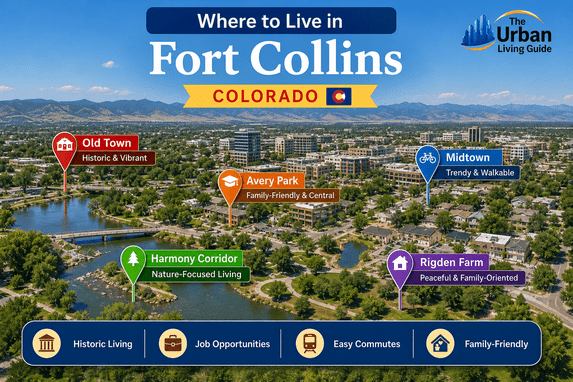
Best Neighborhoods in Fort Collins, Colorado: Historic Old Town, Foothills Trails & Choice City Living in 2026
Covering approximately 57 square miles of land area across the Cache la Poudre River valley along the western edge of the High Plains in Larimer County, the home rule municipality of Fort Collins operates under the council-manager municipal administration of the City of Fort Collins. Housing an incorporated municipal core population exceeding 170,000 residents and anchoring Northern Colorado’s primary economic, technological, and cultural gateway within the thriving Larimer County region, the historic “Choice City” stands as a vital regional engine for higher education, clean-tech innovation, craft brewing, and outdoor recreation.
Relocating across Northern Colorado requires evaluating distinct neighborhood preservation overlays, four-season climate patterns, and regional commuter highway networks overseen by the Colorado Department of Transportation (CDOT). Inbound movers consistently balance direct access to primary regional employers—including the extensive research and academic infrastructure at Colorado State University (CSU), major medical systems anchored by UCHealth Poudre Valley Hospital and Banner Health McKee Medical Center, high-tech engineering firms, and corporate research hubs—against daily highway travel across Interstate 25, US Route 287, Colorado State Highway 14, and College Avenue, with regional air service connecting via Northern Colorado Regional Airport (FNL).
Take a virtual walking tour through the tree-lined historic blocks, craft brewery corridors, and distinctive residential neighborhoods of Fort Collins, Colorado:
Key Residential Districts in Fort Collins at a Glance in 2026
| Neighborhood | Location | Distance to Old Town Square | Development Status | Transit Connectivity | Cost Level | Best Fit For |
|---|---|---|---|---|---|---|
| Old Town (Historic Core) | Central Business & Cultural Basin | 0 mi (Core) | Victorian Architecture & Gas-Lit Streets | Exceptional (Transfort Hub, College Ave) | High-to-Premium | Professors, Young Professionals & Walkability Seekers |
| Campus West (CSU Adjacent) | Western CSU Corridor | ~1.5 mi west | Student Infill & Mid-Century Residential | High (Transfort Routes, Shields St) | Mid-Range | CSU Students, Faculty & Real Estate Investors |
| Foothills (Southwest Enclave) | Western Mountain Slopes | ~3.5 mi southwest | Trail-Adjacent Custom Suburbs | High (Taft Hill Rd, Drake Rd) | Premium | Hikers, Cyclists & Custom Home Buyers |
| Rigden Farm (Southeast Master-Planned) | Southeastern Plateau | ~4 mi southeast | Master-Planned Traditional Neighborhood | High (Stover St, Horsetooth Rd) | Mid-to-High | Growing Families & Medical Personnel |
| Timberline (Eastern Suburban Corridor) | Eastern Plains Approach | ~4.5 mi east | Modern Subdivisions & Tech Parks | High (Timberline Rd, I-25 Access) | Accessible / Mid-Range | I-25 Commuters & First-Time Homebuyers |
Comprehensive Breakdown of the Best Neighborhoods in Fort Collins
Old Town — Victorian Architecture, Gas-Lit Streetscapes & Historic Square Vitality
Covering the historic commercial and residential grid centered around Old Town Square and College Avenue, Old Town is widely recognized as Colorado’s premier historic downtown district (reputedly serving as the architectural inspiration for Disneyland’s Main Street U.S.A.). Operating under City of Fort Collins municipal administration and supported by the Downtown Fort Collins Business Association, the district preserves vibrant 19th-century brick commercial blocks and surrounding residential lanes.
The neighborhood is defined by towering mature elms, preserved Victorian and Craftsman homes, boutique outdoor patios, and direct walking proximity to Colorado State University, delivering an unmatched pedestrian lifestyle for academics and urban professionals.
- Housing: Real estate inventory spans historic late 19th-century Victorian single-family homes, classic brick Craftsman bungalows, modern urban townhomes, and stylish loft conversions. Single-family purchase prices typically range from $550,000 to $1,200,000+, while residential rentals average $1,600 to $2,800 per month.
- Safety & Crime Rate: Patrolled by the Fort Collins Police Services (FCPS) Central District Command. Old Town maintains reliable urban safety standards, supported by active community policing, well-lit pedestrian corridors, and dedicated downtown bicycle patrols.
- School District & Education Quality: Governed by the acclaimed Poudre School District (PSD), zoned to institutions like Lincoln Middle School and Fort Collins High School, while bordering the eastern edge of Colorado State University.
- Walkability & Daily Conveniences: Outstanding pedestrian walkability (Walk Score of 92-96/100 around Old Town Square). Residents easily stroll to over 80 independent restaurants, craft cocktail lounges, boutique shops, the Fort Collins Food Co-op, and year-round community festivals.
- Parks & Green Spaces / Pet-Friendliness: Direct access to the landscaped lawns of Washington Park, Library Park, and the extensive multi-use paved trails along the Cache la Poudre River Trail System. Exceptionally pet-friendly with numerous dog-welcoming patios.
- Parking & Traffic Congestion: Plentiful private residential driveways and alley garages in surrounding historic blocks; downtown metered street parking is well-managed. Traffic flows smoothly along College Avenue and Mountain Avenue.
- Noise Levels & Vibe: Energetic, cultured, and historic, characterized by outdoor café diners, bicycle commuters, local street musicians, and vibrant community spirit.
- Medical Facilities & Hospitals: Direct 6-minute commute south to comprehensive acute care at UCHealth Poudre Valley Hospital on Lemay Avenue.
- Transit Connectivity: High-frequency public transit provided by Transfort bus routes and the MAX Bus Rapid Transit (BRT) line running along Mason Street, offering swift transit across the city and vehicular links to Hwy 287 and I-25.
- Affordability: Premium urban tier; higher acquisition values are offset by historic architectural preservation, unmatched pedestrian access to dining, and strong long-term equity stability.
- Who It’s Best For: University professors, medical staff at Poudre Valley Hospital, young professionals, and buyers seeking classic architectural charm surrounded by an active arts culture.
- Drawbacks: Older home radiator heating and historic preservation restrictions, higher property acquisition costs, and weekend foot-traffic congestion during community events.
Campus West — CSU Student Proximity, Mid-Century Charm & Local Eateries
Situated along the western perimeter of the Colorado State University campus centered around Shields Street and Elizabeth Street, Campus West is celebrated as Fort Collins’ most vibrant collegiate and student-oriented urban neighborhood. Supported by the City of Fort Collins and university student associations, the district blends academic housing with casual neighborhood commerce.
The neighborhood offers mid-century ranch homes, student rental properties, popular neighborhood pubs, coffee shops, and instant bicycle access to campus classroom buildings.
- Housing: Real estate stock features mid-century single-family brick ranch homes, split-level properties, student-focused townhomes, and modern multi-family apartment complexes. Single-family purchase prices typically range from $420,000 to $680,000, while student-oriented rentals average $1,100 to $2,100 per month.
- Safety & Crime Rate: Patrolled by the Fort Collins Police Services West District and CSU Police Department, maintaining secure residential streets with heightened community oversight during academic semesters.
- School District & Education Quality: Governed by Poudre School District, providing local public elementary and middle options while sitting adjacent to Colorado State University’s main campus facilities.
- Walkability & Daily Conveniences: Exceptional collegiate walkability (Walk Score exceeding 85/100). Residents walk to campus libraries, athletic stadiums, local pizza shops, bookstores, and neighborhood grocery outlets.
- Parks & Green Spaces / Pet-Friendliness: Municipal recreation includes proximity to City Park (featuring Sheldon Lake, paddleboarding, swimming pools, and extensive open turf) and the Spring Creek Trail. Highly pet-friendly neighborhood streets.
- Parking & Traffic Congestion: Residential parking permit restrictions apply on high-density student blocks; single-family homes feature private driveways and detached garages. Bicycle traffic is exceptionally heavy along campus corridors.
- Noise Levels & Vibe: Collegiate, youthful, and active, characterized by bicycle riders, student scholars, game-day excitement, and bustling commercial strips.
- Medical Facilities & Hospitals: Direct 5-minute drive east to the CSU Health Network campus clinic and UCHealth Poudre Valley Hospital.
- Transit Connectivity: High-frequency Transfort bus lines connect Campus West directly to Old Town Square, the downtown transit center, and major commercial hubs.
- Affordability: Mid-range urban price tier; provides solid real estate investment potential and accessible single-family housing options near the university.
- Who It’s Best For: CSU faculty, university students, real estate investors, and buyers seeking an energetic, bicycle-centric lifestyle.
- Drawbacks: High student renter turnover on specific blocks, weekend game-day parking congestion, and lively evening noise levels.
Foothills (Southwest Enclave) — Mountain Foothills Trails, Custom Estates & Horsetooth Proximity
Situated along the dramatic western slope of the city beneath the shadow of Horsetooth Mountain along Taft Hill Road and Drake Road, the Foothills district represents Fort Collins’ premier mountain-adjacent luxury residential sanctuary. Governed through City of Fort Collins municipal planning, the area sits at the threshold of the Rocky Mountain foothills.
Celebrated for its custom architecture, mature pine trees, proximity to Lory State Park and Horsetooth Reservoir, and elite outdoor recreation access, the Foothills provides an upscale natural lifestyle within minutes of commercial amenities.
- Housing: Real estate stock features custom 1970s–2020s executive single-family homes, spacious daylight basement properties on large landscaped lots, and luxury custom builds in exclusive enclaves. Single-family purchase prices typically range from $750,000 to $1,600,000+.
- Safety & Crime Rate: Protected by Fort Collins Police Services South District Command, the Foothills consistently records some of the lowest property and violent crime rates in Larimer County.
- School District & Education Quality: Governed by the Poudre School District, containing top-performing public institutions such as Blevins Middle School and Rocky Mountain High School.
- Walkability & Daily Conveniences: Automobile-dependent for major retail, though neighborhood trailheads connect directly to city-wide bike paths, with shopping centers along Shields Street and Drake Road providing grocery stores and dining.
- Parks & Green Spaces / Pet-Friendliness: World-class natural recreation anchored by direct proximity to Horsetooth Reservoir (boating and fishing), Maxwell Natural Area, and the foothills trail networks. Exceptionally pet-friendly.
- Parking & Traffic Congestion: Generous private multi-car garages and expansive driveways keep neighborhood streets clear. Commuter traffic builds along Taft Hill Road during morning and evening rush hours.
- Noise Levels & Vibe: Serene, refined, and nature-focused, characterized by mountain views, cycling enthusiasts, wildlife, and quiet residential evenings.
- Medical Facilities & Hospitals: Direct 8-minute drive east to UCHealth Poudre Valley Hospital and specialized medical clinics.
- Transit Connectivity: Road travel connects quickly via Taft Hill Road and Horsetooth Road, offering a 10-minute drive into Old Town and fast access to western mountain recreation.
- Affordability: High-tier suburban luxury price profile; higher real estate acquisition costs are balanced by direct mountain access and top-tier school ratings.
- Who It’s Best For: Mountain hikers, avid cyclists, executive professionals, and families prioritizing premier Poudre School District enrollment.
- Drawbacks: Higher purchase prices per square foot, complete automobile reliance for daily errands, and high homeowner demand.
Rigden Farm (Southeast Master-Planned) — Traditional Neighborhood Design, Community Parks & Medical Proximity
Covering the vibrant southeastern master-planned plateau along Stover Street and Horsetooth Road, Rigden Farm is celebrated as one of Fort Collins’ most successful traditional neighborhood development (TND) communities. Operating under master community standards, the neighborhood emphasizes pedestrian connectivity and architectural diversity.
The neighborhood provides classic front-porch single-family homes, alley-loaded townhomes, neighborhood pocket parks, and immediate proximity to major medical and research campuses.
- Housing: Real estate inventory spans traditional single-family homes with welcoming front porches, alley-fed carriage garages, maintenance-free townhomes, and patio properties. Single-family purchase prices typically range from $500,000 to $850,000, while townhomes average $380,000 to $540,000.
- Safety & Crime Rate: Patrolled by the Fort Collins Police Services East District, maintaining dependable neighborhood security, active block watch participation, and safe family streetscapes.
- School District & Education Quality: Governed by the Poudre School District, featuring neighborhood elementary schools and convenient proximity to high-achieving middle and high school campuses.
- Walkability & Daily Conveniences: Exceptional traditional neighborhood design walkability. Residents stroll to onsite commercial plazas hosting local coffee shops, banking, professional services, and neighborhood medical offices.
- Parks & Green Spaces / Pet-Friendliness: Municipal recreation is anchored by central community green spaces, neighborhood playgrounds, and integrated connections to the Power Trail system. Highly pet-friendly.
- Parking & Traffic Congestion: Intelligent alley-load garage designs keep street frontages free of parked cars, maintaining clear, safe lanes for neighborhood pedestrians and cyclists.
- Noise Levels & Vibe: Family-oriented, friendly, and active, characterized by children playing in front yards, community walkers, and quiet suburban evenings.
- Medical Facilities & Hospitals: Direct 5-minute drive north to major medical office complexes and 8 minutes to UCHealth Poudre Valley Hospital.
- Transit Connectivity: Excellent roadway integration via Horsetooth Road and Stover Street, offering fast connections to Lemay Avenue and Interstate 25 commuter lanes.
- Affordability: Mid-to-high suburban tier; delivers modern construction, energy-efficient floor plans, and walkable community amenities at competitive valuations.
- Who It’s Best For: Growing families, medical professionals, downsizers, and buyers seeking traditional neighborhood charm with modern infrastructure.
- Drawbacks: HOA covenants regulating exterior home modifications and moderate traffic on major bordering arterial roadways.
Timberline (Eastern Suburban Corridor) — Modern Subdivisions, Tech Parks & I-25 Commuter Access
Covering the expansive eastern suburban expansion corridor along Timberline Road and Harmony Road, the Timberline district represents Fort Collins’ modern economic and technological powerhouse. Governed through City of Fort Collins municipal planning, the area accommodates major high-tech employers and rapid residential growth.
The neighborhood features contemporary single-family subdivisions, master-planned corporate office parks, expansive community sports complexes, and effortless highway access for cross-state commuters.
- Housing: Real estate stock features modern 1990s–2020s two-story single-family homes, energy-efficient suburban builds, and contemporary townhome communities. Single-family purchase prices typically range from $450,000 to $750,000, while residential rentals average $1,400 to $2,300 per month.
- Safety & Crime Rate: Patrolled by the Fort Collins Police Services East District Command, ensuring reliable suburban security and peaceful modern subdivision living.
- School District & Education Quality: Governed by the Poudre School District, featuring modern public schools equipped with advanced technology and STEM curricula.
- Walkability & Daily Conveniences: Suburban master-planned layout; residents drive short distances to major shopping centers along Harmony Road, including Costco, Sprouts, and diverse dining plazas.
- Parks & Green Spaces / Pet-Friendliness: Municipal recreation is anchored by Twin Silo Park (featuring a massive community playground, dog park, community gardens, and zip lines). Exceptionally pet-friendly.
- Parking & Traffic Congestion: Plentiful private multi-car garages and wide residential streets. Harmony Road and Timberline Road experience heavy commuter volume during morning and evening rush hours.
- Noise Levels & Vibe: Clean, modern, and efficient, characterized by corporate professionals, tech workers, school sports leagues, and suburban convenience.
- Medical Facilities & Hospitals: Convenient 8-minute drive to UCHealth medical centers and emergency facilities operating along the Harmony Road corridor.
- Transit Connectivity: Outstanding expressway access via Interstate 25 and Harmony Road, offering a 45-minute drive south to Denver or north to Cheyenne.
- Affordability: Accessible-to-mid suburban price tier; offers modern energy-efficient square footage and spacious yards at competitive price points.
- Who It’s Best For: Tech workers, I-25 commuters, growing families, and buyers wanting modern construction with excellent park access.
- Drawbacks: High traffic volume along Harmony Road during peak commuting hours and a more uniform suburban aesthetic.
Neighborhood Evaluation: Weighing Living Merits and Shortfalls Across Fort Collins
| Neighborhood | Core Advantages (Pros) | Core Limitations (Cons) |
|---|---|---|
| Old Town | Historic Victorian architecture; walkable Old Town Square dining; proximity to CSU. | Higher property acquisition costs ($550k+); older home maintenance. |
| Campus West | Immediate CSU campus walkability; vibrant local pubs; bicycle-centric culture. | Student renter turnover; game-day parking congestion; evening noise. |
| Foothills | Direct mountain trail access; Horsetooth Reservoir proximity; custom luxury homes. | Steep purchase price barrier; automobile dependence for daily errands. |
| Rigden Farm | Traditional neighborhood design; walkable commercial plazas; excellent family parks. | HOA exterior modification rules; arterial road traffic. |
| Timberline | Modern energy-efficient homes; Twin Silo Park amenities; fast I-25 commuter access. | Heavy rush-hour congestion on Harmony Road; uniform suburban layout. |
Local Perspectives: What Area Residents Reveal About Living in Fort Collins, Colorado
“Living near Old Town gives us the ultimate Colorado college-town lifestyle. We can walk to farmers markets, enjoy local craft breweries, and bike everywhere without ever touching our car keys.”
— Minu Vance, CSU Research Scientist (Verified Local Contributor, Choice City Community Forum)
“Moving to the Foothills district put us right at the base of Horsetooth Mountain. We hike the trails every weekend and still reach our medical offices in Poudre Valley Hospital within minutes.”
— Neru Jenkins, Clinical Nurse Specialist (Verified Resident Review, Northern Colorado Living Insights)
Matching Your Personal Lifestyle with the Right Choice City Community
Selecting your ideal community in Fort Collins requires balancing your household budget with daily workplace destinations, school enrollment choices, and regional transportation logistics. Because Larimer County is framed by the Rocky Mountain foothills and interconnected by major expressways like Interstate 25 and US Route 287, your chosen location dictates whether your daily commute prioritizes historic Victorian walkability in Old Town, collegiate proximity in Campus West, mountain trail access in the Foothills, traditional neighborhood charm in Rigden Farm, or fast I-25 commuting in Timberline.
University researchers at CSU, medical specialists at Poudre Valley Hospital, tech professionals, and outdoor recreation enthusiasts should evaluate regional transit routes to optimize daily convenience.
Beyond transportation corridors, evaluate essential municipal utility and building infrastructure realities. Northern Colorado experiences over 300 days of sunshine alongside heavy winter alpine snowstorms, making home energy efficiency through Fort Collins Utilities an essential consideration.
In addition, prospective homebuyers evaluating historic properties in Old Town should inspect electrical wiring, plumbing stacks, and historic conservation district guidelines. Before executing a residential lease or property purchase agreement, verify high-speed fiber broadband availability (such as ConnXus municipal fiber or Xfinity Gigabit) and confirm Poudre School District enrollment boundaries.
Essential Local Insights & FAQs for Fort Collins, Colorado
Which neighborhood in Fort Collins is considered best for historic Victorian architecture and walkable dining?
Old Town is widely regarded as the premier historic district in Northern Colorado, offering restored Victorian homes, gas-lit streetscapes, and pedestrian access to Old Town Square dining and CSU.
What is the top campus-adjacent neighborhood for CSU students and faculty?
Campus West provides immediate proximity to Colorado State University classroom buildings, mid-century ranch homes, student housing, and vibrant local eateries along Shields Street.
Are there luxury foothill communities offering direct mountain trail and reservoir access?
Yes, the Foothills district along the western mountain slopes offers custom executive homes, mature pine trees, and direct proximity to Horsetooth Reservoir and Lory State Park.
What are the top master-planned communities featuring traditional neighborhood design?
Rigden Farm offers classic front-porch single-family homes, alley-loaded townhomes, pocket parks, and walkable commercial plazas.
How manageable is the daily commute from Fort Collins into Denver or Cheyenne?
Commuting across the region is highly efficient via Interstate 25 and US-287, allowing residents to navigate between local tech employers and regional hubs within 15 to 45 minutes.
Which eastern corridor is best for I-25 commuters and modern tech workers?
Timberline features energy-efficient modern subdivisions, Twin Silo Park amenities, and immediate access to Harmony Road and Interstate 25.
Is Fort Collins an affordable place to live compared to Denver and coastal metros?
Yes, Fort Collins’ overall cost of living and housing purchase prices remain significantly more accessible than Denver proper and major California coastal metros, offering world-class outdoor recreation, top-tier Poudre schools, and a robust clean-tech job market at an exceptional economic value.
Fort Collins, Colorado Relocation Resources & Living Guides
Fort Collins, Colorado Relocation Resources & Living Guides
Relocating to a fast-growing urban hub requires reliable local data on municipal transit, neighborhood safety, and housing markets. The Urban Living Guide provides comprehensive, data-backed community resources to help working professionals, families, and property investors make informed decisions when moving to major metropolitan areas.
Discover our in-depth guides for Fort Collins and Larimer County:
- Living in Fort Collins, Colorado
- Cost of Living in Fort Collins, Colorado
- Pros and Cons of Living in Fort Collins, Colorado
Planning your upcoming move to the Choice City? Read our complete step-by-step moving strategy: Moving to Fort Collins, Colorado.
Stay connected with The Urban Living Guide for continuous neighborhood spotlights, regional transit updates, and expert real estate analysis across Greater Fort Collins and the state of Colorado.